Karen Wu, California State University, Los Angeles, United States
published in the Proceedings of the 3rd International Conference on Love and Relationship Studies, 6-8 March, 2026
Introduction
Despite the significance that American culture places on the expression “I love you”, little research has examined the meaning of these words. Existing research indicates that cultures differ in how frequently they use the expression “I love you” across various relationships (Wilkins & Gareis, 2006). For example, compared to those born in the United States (US), US immigrants and sojourners tend to use it more selectively, mostly within romantic contexts. Furthermore, women use it more than men do. The question remains, what do people mean when they say “I love you” to a romantic partner? Do they mean that they are committed, that they feel close and intimate, or that they are attracted to the partner? And how do their partners interpret these expressions of love? How does culture shape these meanings?
The aim of this study was to go beyond the frequency of usage and investigate the meaning of “I love you” across gender, ethnicity, and immigrant generational status in the US population. I further examined how interpretations of “I love you” from a current romantic partner differed by the participant’s and their partner’s gender and ethnicity.
Methods
Participants were 1093 undergraduate students at a large public university in Southern California (US) who were in a romantic relationship and said “I love you” to their current partner and/or heard their current partner tell them “I love you”. Researchers asked participants the questions, “What does ‘I love you’ mean when you say it to your current romantic partner?” and/or “What do you believe your current romantic partner means when they say ‘I love you’ to you?” Participants responded to six statements on a scale from 1 = “Not at all” to 5 = “Extremely” reflecting commitment (“I want to be with you forever”, “I unconditionally accept you”), intimacy (“I care deeply for you”, “I can truly be myself around you”), and sexual desire (“I want to engage in sexual activities with you”, “I possess a powerful sexual attraction towards you”).
Repeated measures ANOVA with post-hoc LSD tests were used to assess overall differences in the meaning or interpretation of “I love you” (i.e., ratings of the six statements) within groups. One-way ANOVAs with post-hoc Tukey HSD tests were used to test differences in the meaning or interpretation of “I love you” by ethnicity (self: 790 Latinx, 123 Asian, 50 Black, 30 White; partner: 731 Latinx, 111 Asian, 55 Black, 70 White) and generational status [self: 207 third generation or higher, 733 second generation, 72 1.5 generation (moved to the US before age 13), 36 first generation] and independent samples t-tests were used to test gender differences in the meaning of interpretation of “I love you” (self: 792 women, 257 men; partner: 304 women, 769 men).
Results
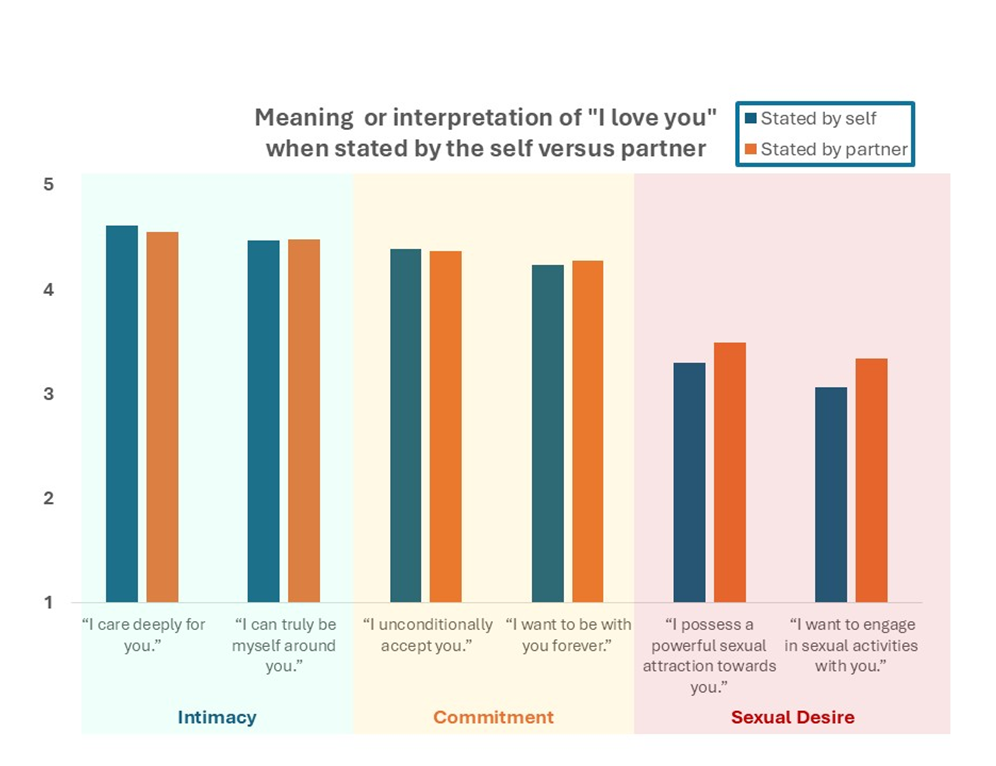
As shown by the blue bars in the graph, overall, participants tended to use “I love you” to convey intimacy, to a lesser degree, commitment, and to a lesser degree, sexual desire. As shown by the orange bars, they interpreted the expression similarly from their partners, believing that “I love you” meant intimacy the most, to a lesser degree, commitment, and to a lesser degree, sexual desire.
However, differences were found in the groups by gender, ethnicity, and immigrant generational status. Compared to men, women were less likely to use “I love you” to convey sexual desire and more likely to use it to convey commitment and intimacy. Women and those with male partners were more likely than men and those with female partners, respectively, to believe that their partners used it to convey commitment and intimacy. Additionally, Asian Americans were less likely to use “I love you” to convey sexual desire compared to Latinx. A Black partner’s expression of love was less likely to be interpreted as intimacy, whereas an Asian partner’s expression was marginally more likely to be interpreted as intimacy. First-generation participants were less likely to use “I love you” to convey commitment and intimacy compared to 1.5-generation participants and interpreted it similarly from a partner.
Conclusion
In summary, the meaning of “I love you” differs by gender and, to a lesser extent, by ethnicity. Women, compared to men, tend to use it more to convey commitment and intimacy and less to convey sexual desire. Compared to Latinx, Asian Americans use it less to convey sexual desire. However, people may not have knowledge of these differences and may instead project their beliefs onto their partners or rely on social scripts. Future studies should utilize partner reports to assess potential misinterpretations of the meaning of “I love you” and their association with relationship quality.
References
Wilkins, R., & Gareis, E. (2006). Emotion expression and the locution “I love you”: A cross-cultural study. International Journal of Intercultural Relations, 30(1), 51-75.