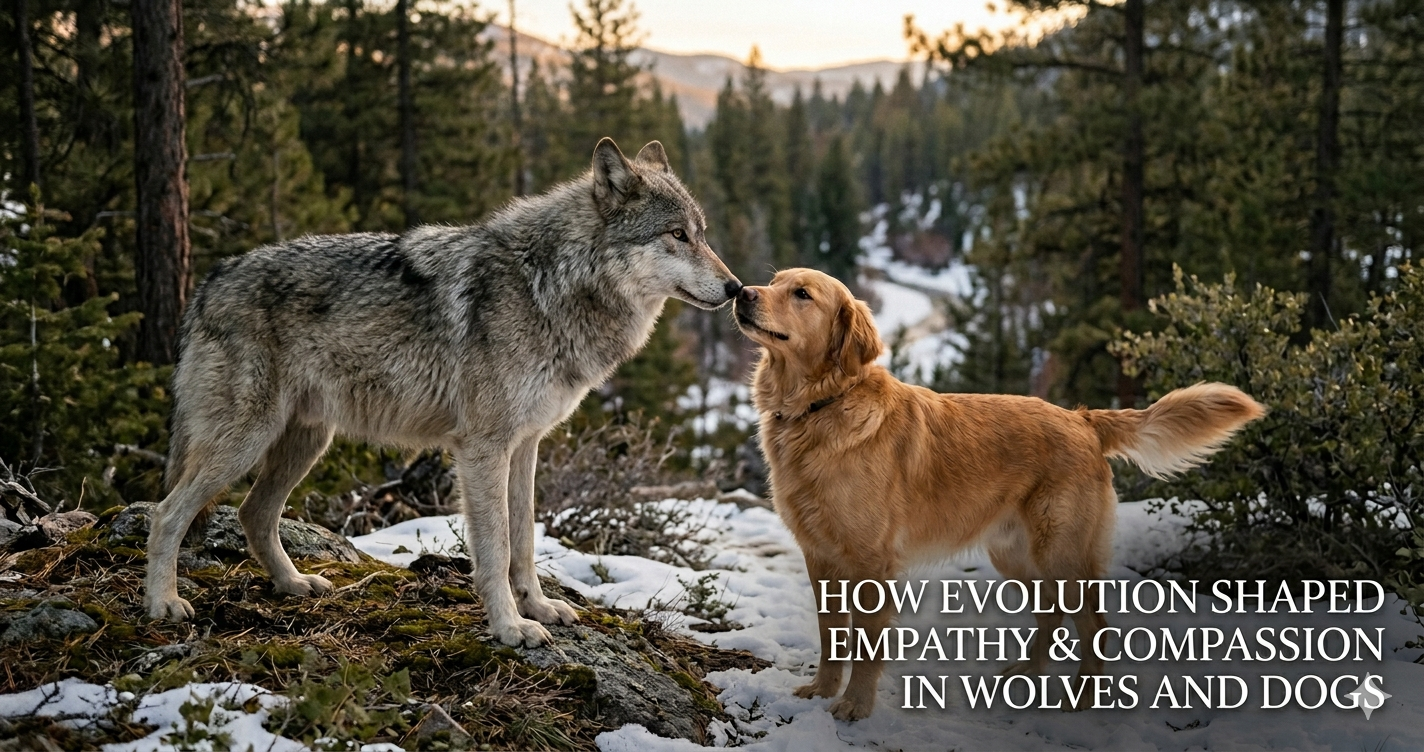
For centuries, people have viewed the dog as “man’s best friend” and the wolf as the “lone predator.” However, modern science is blurring these lines, revealing that both may have the capacity for empathy and compassion and behave prosocially toward their peers and humans. In science, the tendency to help others at a cost to oneself is known as prosocial behavior.
Studies recently have found that canines—both domestic and wild—have far more complex emotional lives and behavior than researchers previously thought. In this article, I consider how and why empathy and compassion have evolved in the histories of canine species, while in the following article, I will present the variety of ways that wolves and dogs express their empathy and exhibit compassionate behavior.
In other articles, you may be interested to learn about cooperative behaviors, empathetic expressions, and prosocial actions that scientists observed in other animals, such as rats and mice and primates.
The Survival of the Friendliest: Why Empathy Matters in Canines
Canines are mammals belonging to the biological family Canidae, including domestic dogs, wolves, coyotes, jackals, and foxes. Being mammals likely makes them capable of love.
A combination of evolutionary necessity, social bonding, and neurobiological mechanisms has driven the evolution of empathy and compassion in canids, specifically wolves (Canis lupus) and domestic canines (Canis lupus familiaris). Although both species demonstrate “prosocial” behaviors (voluntary actions that benefit others), their manifestations are distinct as a result of the selective pressures of domestication versus life in cooperative groups (Range & Virányi, 2014).
Wolves cooperatively hunt and protect their packs, while domestic dogs often display such behaviors as seeking human attention and sharing resources with humans.
The Science of Connection: The Social and Biological Glue of the Pack
The biological evolutionary mechanisms behind these behaviors have evolved to benefit the survival and social stability of these species. Here are the three major factors driving this evolution:
- Cooperative breeding & survival: For wolves, survival depends on pack cohesion. Helping behaviors, such as allomaternal care (non-breeding members helping raise young), are essential (Range & Virányi, 2014). Empathy facilitates the coordination and helping required for these cooperative structures (Range & Virányi, 2014).
- Social bonding: Prosociality strengthens social ties within a group. Emotional contagion serves as a “social glue,” allowing individuals to converge emotionally and maintain group harmony (Madsen & Persson, 2012).
- The oxytocin system: Compassionate behavior is mediated by the oxytocin system, which is highly conserved across mammals (Kis et al., 2014). Genetic polymorphisms in the oxytocin receptor gene (OXTR) are associated with variations in proximity seeking, friendliness, and empathy-like responses in dogs (Kis et al., 2014; Oláh et al., 2017).
How Canines Love Beyond the Species Borders: Evolution of Cross-Species Empathy
While wolves and dogs are both capable of empathy, how does their empathetic behavior differ? Empathy in the canine world is a spectrum of variations.
Wolves are capable of cooperative behaviors and compassion within their pack, prioritizing the survival, well-being, and care of members within their families. Wolves’ compassion is an evolutionary tool for survival, built on loyalty and cooperation within a group.
Dogs took that evolutionary blueprint and expanded the mechanisms of empathy and compassion further, building an emotional bridge across species. Dogs can exhibit interspecific empathy—the ability to feel across species lines. From wild wolves sharing food to pet dogs comforting their owners, it’s clear that caring for others is a natural part of who they are.
Dogs have undergone a “brain restructuring” over the last 15,000 years, shifting their primary survival strategy from self-reliance to human connection (Lazzaroni et al., 2025). This evolution has enabled them to form strong bonds with humans and adapt their behaviors to better communicate and cooperate with people. It is worth noting that this “brain restructuring” isn’t just a biological fact—it’s the reason why the dog sitting on someone’s rug can sense when they’ve had a bad day.
References
Kis, A., Bence, M., Lakatos, G., Pergel, E., Turcsán, B., Pluijmakers, J., Vas, J., Elek, Z., Brúder, I., Földi, L., Sasvári-Székely, M., Miklósi, Á., Rónai, Z., & Kubinyi, E. (2014). Oxytocin Receptor Gene Polymorphisms Are Associated with Human Directed Social Behavior in Dogs (Canis familiaris). PLoS ONE, 9(1), e83993. https://doi.org/10.1371/journal.pone.0083993
Madsen, E. A., & Persson, T. (2012). Contagious yawning in domestic dog puppies (Canis lupus familiaris): the effect of ontogeny and emotional closeness on low-level imitation in dogs. Animal Cognition, 16(2), 233-240. https://doi.org/10.1007/s10071-012-0568-9
Oláh, K., Topál, J., Kovács, K., Kis, A., Koller, D., Young Park, S., & Virányi, Z. (2017). Gaze-Following and Reaction to an Aversive Social Interaction Have Corresponding Associations with Variation in the OXTR Gene in Dogs but Not in Human Infants. Frontiers in Psychology, 8. https://doi.org/10.3389/fpsyg.2017.02156
Range, F., & Virányi, Z. (2014). Wolves Are Better Imitators of Conspecifics than Dogs. PLoS ONE, 9(1), e86559. https://doi.org/10.1371/journal.pone.0086559