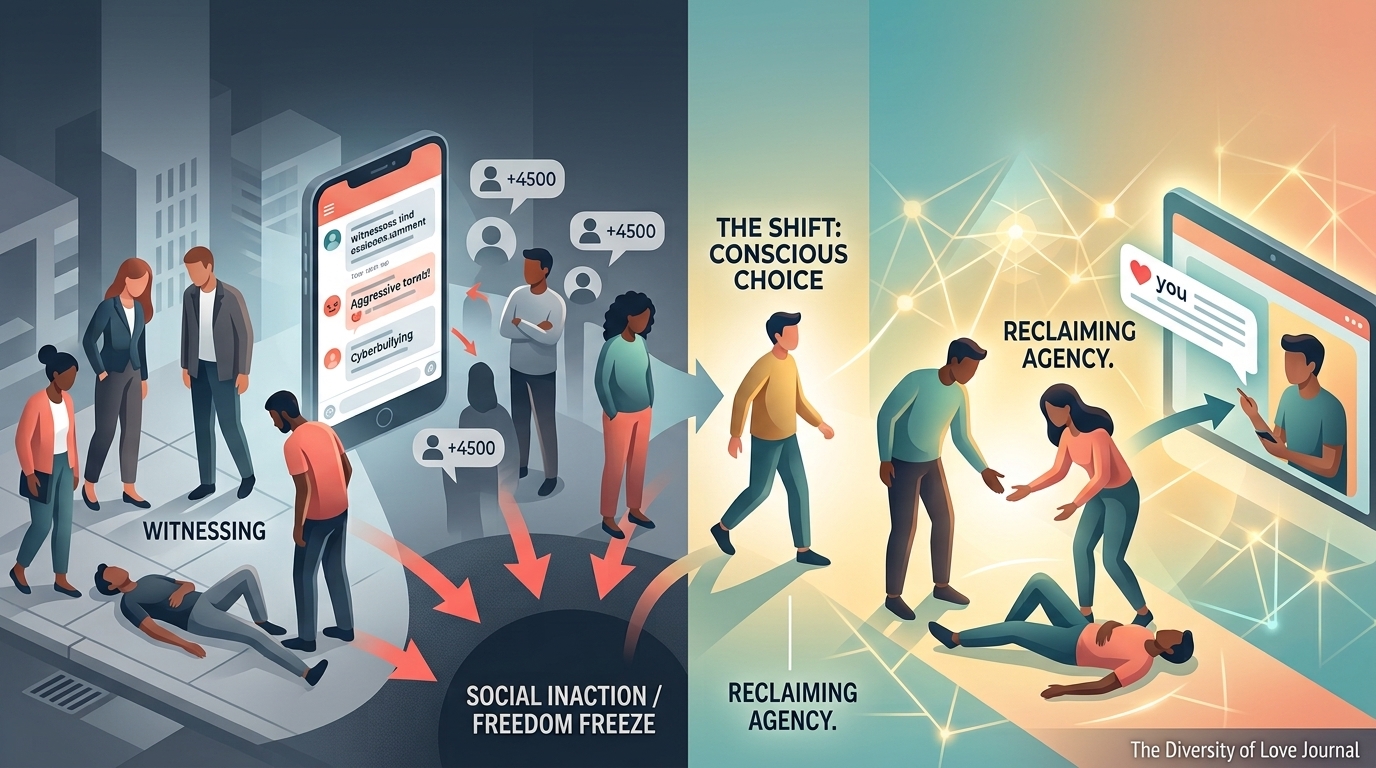
From crowded city streets to viral comment sections, the bystander effect remains one of humanity’s most persistent social traps: the larger the audience, the less likely anyone is to intervene. But bystander paralysis isn’t simply a matter of logic—it’s a crisis of motivation.
This article bridges traditional social psychology and modern cyberpsychology to uncover how passive crowds erode personal responsibility. By reframing compassionate love as an active, goal-directed motivational system, we outline how individuals can reclaim agency, navigate digital scale, and bridge the gap between feeling empathy and taking action.
The Bystander Effect: Diffusion of Responsibility
In 1964, a young woman named Kitty Genovese was brutally attacked and murdered outside her apartment building in Queens, New York. The assault lasted over half an hour. According to initial news reports, 38 neighbors heard or witnessed parts of the attack from their windows, yet not a single person stepped in or called the police during the ordeal.
The public reaction to the news was immediate horror and moral confusion. Media outlets and public commentators cited the incident as evidence of a deeper societal decay. They argued that modern city life had made people cold, alienated, and morally indifferent to the suffering of others.
Social psychologists John Darley and Bibb Latané, however, suspected a different underlying cause. They questioned whether the lack of intervention was truly a matter of individual moral failure. Instead, they set out to resolve a specific scientific problem: Why do fundamentally decent people fail to help when witnessing an emergency in a crowd? (Latané & Darley, 1968, 1970).
Mechanisms of Social Paralysis
Through their breakthrough experiments, Darley and Latané demonstrated that non-intervention is rarely driven by apathy. Instead, inaction is generated by the subtle social dynamics of the group itself. They identified three primary psychological barriers that create social paralysis in public crises:
- Diffusion of Responsibility: As the number of bystanders increases, the perceived personal obligation of any single individual to intervene decreases. People assume that someone else has already called for help or is better suited to handle the emergency.
- Pluralistic Ignorance: When a situation is ambiguous, individuals look to others to determine how to react. Because each person tries to appear calm while observing the crowd, everyone misinterprets the collective composure as a sign that no real emergency exists.
- Evaluation Apprehension: Bystanders hesitate to act out of fear of making a public mistake, misjudging the situation, or facing social disapproval from peers.
By identifying these structural group dynamics, Darley and Latané transformed the scientific understanding of public emergency—shifting the focus from individual moral blame to the predictable psychological forces that inhibit active benevolence in social settings.
The impact of these situational pressures was further demonstrated in Darley and Batson’s (1973) landmark “Good Samaritan” experiment. In an experimental setting, seminary students heading across campus to deliver a presentation—some specifically prepared to speak on the biblical parable of the Good Samaritan—walked past an actor slumped in an alleyway, coughing and groaning in obvious distress.
The primary factor predicting whether a student stopped to assist was not their expressed religious values or the topic of their upcoming talk, but whether they were under time pressure. When placed in a high-hurry condition, 90% of participants passed by the suffering individual. This empirical finding underscored a core reality of relationship science: active benevolence requires not only moral intention, but also the situational bandwidth to act upon it.
Diffusion of Social Empathy: The Affective Dimension
Early research of the bystander effect focused on how people think during critical situations. It framed non-intervention as a series of logical steps, such as assessing threats and weighing costs against benefits. However, this cognitive focus of early studies often overlooked the emotional side of the problem: the gradual diffusion of social empathy.
When multiple observers are present, bystanders do not merely share the cognitive load of deciding how or when to respond; they experience a dampening of personal affective resonance. The presence of passive peers attenuates the emotional urgency that typically mobilizes caregiving behavior, turning compassionate love from an active, energetic impulse into a diluted feeling of shared indifference.
When observing another human being in distress, neural systems trigger a vicarious emotional response (Decety & Jackson, 2004). Normally, this empathy prompts supportive behavior. Within a passive group, however, this emotional connection becomes diluted:
- The Illusion of Shared Obligation: Individuals subconsciously assume that because many are watching, the emotional weight and moral duty are distributed across the group, lessening the individual impulse to act (Darley & Latané, 1968; Latané & Nida, 1981).
- Empathic Paralysis and Dissonance: Observing suffering creates discomfort, but seeing others remain passive produces cognitive conflict: “If this situation requires help, why is no one acting?” To resolve this internal tension, observers often rationalize their inaction by minimizing the victim’s distress or deciding it falls outside their responsibility (Feinberg et al., 2012).
Digital Bystander Paralysis: The Bystander Effect in the Modern Virtual World
In the modern virtual world, such situations of social paralysis extend into digital spaces. In public comment threads, group chats, online forums, and social feeds, the bystander effect operates through distinct mechanics (Hudson & Bruckman, 2004; Voelpel et al., 2008).
Digital environments exacerbate bystander inaction in three ways:
- The Invisible Crowd and Digital Scale: In physical environments, an onlooker can visually count the crowd. Online, visible view metrics show that thousands are witnessing an event—whether cyberbullying, targeted harassment, or a distress signal—which triggers extreme diffusion of responsibility (Barlińska et al., 2013; Obermaier et al., 2016).
- Audience Metrics and Cyberbullying: As public view counts, likes, and comment numbers scale up during online harassment, the perceived necessity for any single user to intervene decreases significantly. The metric display itself reinforces the belief that another spectator among the massive audience will step in or report the behavior (Brody & Vangelisti, 2016).
- Anonymity and Physical Distance: Digital interfaces strip away critical non-verbal social cues, such as vocal tone, eye contact, and body language. This emotional buffer blunts personal responsiveness to distress while user anonymity significantly reduces feelings of individual moral accountability (Bargh et al., 2002; Hudson & Bruckman, 2004).
- Asynchronous Interaction: Unlike physical emergencies that demand immediate real-time decisions, online exchanges unfold across delayed time intervals. This temporal lag allows observers to easily rationalize their silence by assuming someone else has already responded or that a delayed comment will carry little practical weight (Daft & Lengel, 1986; Suler, 2004).
Active Benevolence as Bystander Intervention: Moving Beyond Empathy
To overcome bystander paralysis—whether in a physical crowd or a digital network—merely experiencing empathy is insufficient. While empathy allows an observer to experience internal resonance with another person’s pain, this passive feeling often remains trapped as internal distress or gets blunted by group dynamics. Empathy connects us to another’s pain, but without active motivation, it can lead to emotional exhaustion and disengagement (Eisenberg et al., 1989).
Observers must consciously overcome three critical barriers:
- Managing Self-Oriented Distress: Unmanaged empathy can overwhelm an observer, causing them to turn away to protect their own emotional comfort rather than assisting the victim.
- Reclaiming Personal Agency: Individuals must explicitly reject the assumption that others will intervene, consciously taking personal ownership of the situation despite the presence of a crowd.
- Accepting Social Risk: Active intervention requires an observer to risk public embarrassment, awkwardness, or conflict—prioritizing the victim’s immediate well-being over their own fear of social disapproval.
To transition from passive witnessing to effective action, individuals require active benevolence. Active benevolence elevates empathy from an internal emotional state into a deliberate, goal-directed motivational system. It transforms passive compassion into concrete action, enabling individuals to push past group inertia, accept social risk, and step forward when help is needed most.
Emotional Diffusion & Inaction
Active Benevolence & Intervention
Active benevolence reshapes bystander intervention through three deliberate shifts:
- 1. Reorienting Attention from Self-Protection to Care
- Evaluation apprehension stems from self-protection (“How will I look if I make a mistake?”). Active benevolence directs focus toward the needs and dignity of the victim. When the well-being of the target becomes the primary objective, fear of social awkwardness diminishes (Post, 2003).
- 2. Reclaiming Personal Moral Agency
- An individual guided by active benevolence does not ask, “Why is no one else stepping in?” They recognize that personal moral responsibility cannot be delegated to a group. Active benevolence treats care as a personal obligation. The passivity of others serves as the explicit reason to step forward.
- 3. Activating Prosocial Courage through Micro-Interventions
- Moving from emotional sympathy to tangible action requires prosocial courage—the willingness to step outside social norms to protect another person (Lopez, 2013). Active benevolence supplies the drive necessary for both direct intervention and subtle micro-gestures:
- In Physical Settings: Stepping out of a crowd to stand beside a targeted individual, asking directly, “Are you okay?”, or assigning specific tasks to individuals nearby (“You in the blue coat, please call for help”), which breaks pluralistic ignorance for the crowd.
- In Digital Settings: Refusing to scroll past harassment; posting a stabilizing, constructive comment; reporting abuse; or sending a private, supportive message to the person targeted.
By defining compassionate love as active benevolence, relationship science offers a practical framework to counter bystander paralysis. Whether intervening in a physical gathering or writing a quiet note of support in a noisy digital thread, active benevolence breaks passive group dynamics and restores intentional care to everyday social life.
Related Articles in This Collection:
- Compassionate Love as Active Benevolence
- From Bystander Effect to Active Benevolence: Reclaiming Agency in Physical and Digital Worlds
- Overcoming Time Famine: How Prosocial Action Reclaims Temporal Affluence for Love and Compassion
- Small Love in Seconds: How Micro-Communication and Micro-Gestures Counter Time Famine
- When “Small Love” Is Compassionate: How Situational Urgency and Temporal Scarcity Shape Prosociality
- How Brief Expressions of Compassion Transform Medical and Daily Relationships
- The Benevolence of True Love in Cross-Cultural Perspectives: Universal Meanings and Local Practices
- Love in Action: Active Benevolence and Communal Support in Ghanaian Culture
- Loving-Kindness in Buddhist Culture as a Form of Benevolent Love
- Restoring Compassionate Love in an Era of Digital Urgency
References
- Bargh, J. A., McKenna, K. Y., & Fitzsimons, G. M. (2002). Can you see the real me? Activation and expression of the “true self” on the Internet. Journal of Social Issues, 58(1), 33–48.
- Barlińska, J., Szuster, A., & Winiewski, M. (2012). Cyberbullying among adolescent bystanders: Role of the communication medium, form of violence, and empathy. Journal of Community & Applied Social Psychology, 23(1), 37-51.
- Bargh, J. A., McKenna, K. Y., & Fitzsimons, G. M. (2002). Can you see the real me? Activation and expression of the “true self” on the Internet. Journal of Social Issues, 58(1), 33–48.
- Batson, C. D. (1991). The altruism question: Toward a social-psychological answer. Psychology Press.
- Brody, N., & Vangelisti, A. L. (2016). Bystander intervention in cyberbullying. Communication Monographs, 83(1), 94-119.
- Daft, R. L., & Lengel, R. H. (1986). Organizational information requirements, media richness and structural design. Management Science, 32(5), 554-571.
- Darley, J. M., & Batson, C. D. (1973). “From Jerusalem to Jericho”: A study of situational and dispositional variables in helping behavior. Journal of Personality and Social Psychology, 27(1), 100–108.
- Darley, J. M., & Latané, B. (1968). Bystander intervention in emergencies: Diffusion of responsibility. Journal of Personality and Social Psychology, 8(4), 377–383.
- Decety, J., & Jackson, P. L. (2004). The functional architecture of human empathy. Behavioral and Cognitive Neuroscience Reviews, 3(2), 71–100.
- Eisenberg, N., Fabes, R. A., Miller, P. A., Fultz, J., Shell, R., Mathy, R. M., & Reno, R. R. (1989). Relation of sympathy and personal distress to prosocial behavior: A multimethod study. Journal of Personality and Social Psychology, 57(1), 55–66.
- Feinberg, M., Willer, R., & Keltner, D. (2012). Fluster and reform: Emotional expressions of embarrassment promote prosociality and repair. Journal of Personality and Social Psychology, 102(1), 81–97.
- Hudson, J. M., & Bruckman, A. (2004). The bystander effect: A lens for understanding patterns of participation in online chat rooms. Journal of the Learning Sciences, 13(2), 165–195.
- Latané, B., & Darley, J. M. (1968). Group inhibition of bystander intervention in emergencies. Journal of Personality and Social Psychology, 10(3), 215–221.
- Latané, B., & Darley, J. M. (1970). The unresponsive bystander: Why doesn’t he help? Appleton-Century-Crofts.
- Latané, B., & Nida, S. (1981). Ten years of research on group size and helping. Psychological Bulletin, 89(2), 308–324.
- Latane, B., & Rodin, J. (1969). A lady in distress: Inhibiting effects of friends and strangers on bystander intervention. Journal of Experimental Social Psychology, 5(2), 189–202
- Lopez, S. J. (2013). Making hope happen: Create the future you want for yourself and others. Atria Books.
- Obermaier, M., Fawzi, N., & Koch, T. (2016). Bystanding or standing by? How the number of bystanders affects the intention to intervene in cyberbullying. New Media & Society, 18(8), 1491–1507.
- Post, S. G. (2003). Unlimited love: Altruism, compassion, and service. Templeton Foundation Press.
- Sprecher, S., & Fehr, B. (2005). Compassionate love for close others and humanity. Journal of Social and Personal Relationships, 22(5), 629–651.
- Suler, J. (2004). The online disinhibition effect. Cyberpsychology, Behavior & Social Networking, 7(3), 321-326.
- Underwood, L. G. (2002). The human experience of compassionate love: Conceptual mapping and exemplar interviews. In S. G. Post, L. G. Underwood, J. P. Schloss, & W. B. Hurlbut (Eds.), Altruism and altruistic love: Science, philosophy, and religion in dialogue (pp. 72–88). Oxford University Press.
- Voelpel, S. C., Eckhoff, R. A., & Förster, J. (2008). David against Goliath? Group size and bystander effects in virtual knowledge sharing. Human Relations, 61(2), 271-295.