
Do beliefs in romantic fate hinder relationship investment, or can fate and effort coexist? While Western psychological models often treat destiny and growth as opposing mindsets, non-Western traditions integrate them into a unified cultural framework. In this article, we examine C. Raymond Knee’s implicit relationship theory, map its four mindset quadrants, and explore how Chinese yuán fèn and South Asian karma transform relational fate into an engine for ongoing commitment. (For a foundational look at the phenomenology of fate, see the introductory piece on The Psychology and Phenomenology of Relational Fate).
Implicit Theories of Relationships: The Western Foundation
In his landmark research on implicit theories of relationships, social psychologist C. Raymond Knee (1998) demonstrated that individuals hold fundamental, often subconscious beliefs about how romantic relationships function. Building on the tension between individual agency and cosmic causation (explored in detail in Our Love Destiny in Life), Knee categorized these implicit theories into two distinct dimensions: Destiny Beliefs and Growth Beliefs.
These two mindsets operate independently rather than as mutually exclusive opposites—meaning a person can hold high or low levels of either or both. Together, they shape how partners evaluate compatibility, navigate conflict, and determine long-term commitment.
1. Destiny Beliefs (“The Soulmate Mindset”)
Destiny beliefs center on the conviction that romantic relationships are either inherently ‘meant to be’ or they are not. As analyzed in our companion article on the psychology of love destiny, individuals high in destiny beliefs assume that potential partners are either compatible from the start or fundamentally incompatible
- Core Premise: Compatibility is fixed and predetermined; love is about discovering the right person.
- Relationship Evaluation: Initial impressions carry extraordinary weight as partners rapidly assess whether an individual matches an ideal baseline (“Is this my soulmate?”).
- Handling Conflict: Because compatibility is viewed as fixed, relational friction is often interpreted as evidence that the union was simply “not meant to be”. Consequently, during crisis, high destiny believers are prone to avoidant coping or swift disengagement.
- Satisfaction Dynamics: When a relationship runs smoothly, high destiny believers experience exceptional satisfaction and deep commitment, feeling they have successfully secured their preordained partner.
2. Growth Beliefs (“The Work-It-Out Mindset”)
Growth beliefs revolve around the conviction that romantic relationships are cultivated, developed, and strengthened over time through mutual effort, open communication, and compromise.
- Core Premise: Compatibility is cultivated rather than found; love is an ongoing process of learning and adapting together.
- Relationship Evaluation: Initial impressions and immediate chemistry are less critical, as partners allow time for potential to mature.
- Handling Conflict: Conflict is viewed as a natural, expected, and constructive component of relationship development. Friction prompts active, problem-focused coping to deepen mutual understanding.
- Satisfaction Dynamics: Relational stability remains resilient even during difficult periods because hardship does not automatically threaten the underlying viability of the union.
The Four Mindset Quadrants
Because destiny and growth beliefs operate as independent axes, individuals fall into one of four distinct combination profiles:
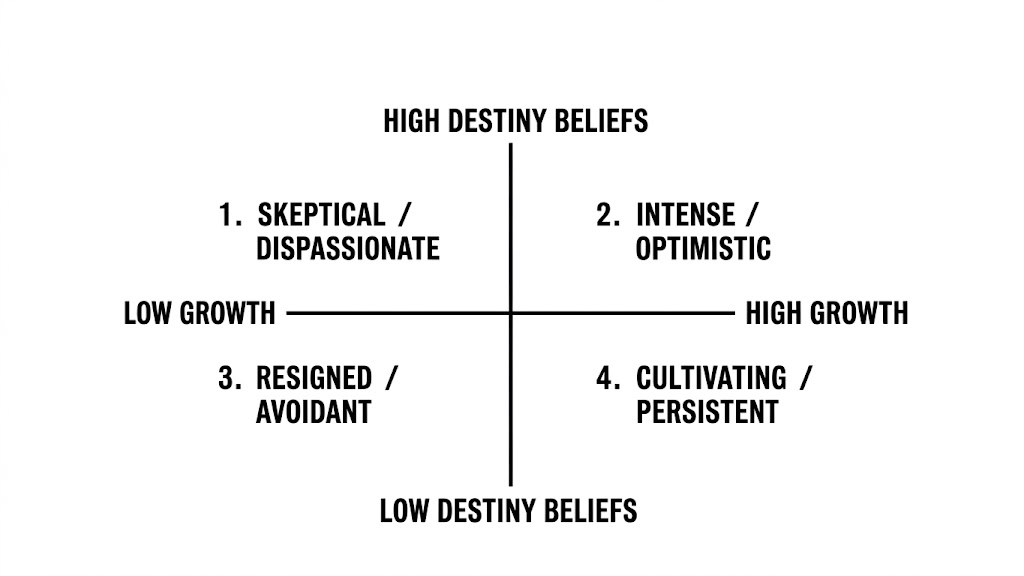
- High Destiny / High Growth (Intense / Optimistic): Believes in finding a preordained partner, but recognizes that sustaining the connection requires continuous effort and mutual cultivation once found.
- High Destiny / Low Growth (Pure Soulmate View): Expects effortless harmony; highly vulnerable to abrupt dissolution or disengagement at the first sign of serious conflict.
- Low Destiny / High Growth (Cultivating / Workhorse View): Dismisses the concept of “the One,” maintaining that almost any relationship can thrive if both partners dedicate genuine effort.
- Low Destiny / Low Growth (Resigned / Disengaged): Doubts that predetermined compatibility exists while simultaneously lacking faith that personal effort can improve relational outcomes.
Western vs. Non-Western Synthesis: Bridging Fate and Effort
While Knee’s (1998) model was developed within Western individualist social psychology, its constructs map onto non-Western concepts of fate in subtle and profound ways. Building on our broader cross-cultural examination of fatalistic love constructs (see Destined Love Across Cultures), non-Western paradigms frequently combine fate and effort into a single, cohesive cultural logic.
| Feature | Knee’s Western Destiny Beliefs | Chinese Yuán Fèn Framework | South Asian Karma & Dharma |
| Source of Fate | Romantic ideal / “The One” (Knee, 1998). | Predestined relational affinity (Goodwin & Findlay, 1997). | Cosmic balance / Past-life actions (Dion & Dion, 1996; Karandashev, 2017). |
| View of Incompatibility | Sign to disengage or leave (Knee, 1998). | A challenge requiring patience and endurance (Yang, 2006). | A karmic debt or lesson to resolve together (Bejanyan et al., 2014). |
| Response to Friction | Avoidance or swift dissolution. | Harmony preservation; social-defensive buffering (Yang, 2006). | Perseverance through moral obligation (dharma) (Bejanyan et al., 2014). |
1. Intersection with Chinese Yuán Fèn (Predestined Affinity)
In Chinese culture, yuán or yuán fèn refers to a predestined affinity that brings two individuals together (Goodwin & Findlay, 1997; Yang, 2006). As detailed in our overview of predestined love in Asian cultural traditions, while it resembles Western destiny beliefs on the surface, its psychological function differs significantly:
- Fate as Opportunity, Not Ease: Fate dictates the initial encounter and relational connection, not guaranteed compatibility (Goodwin & Findlay, 1997).
- Ego-Defensive Function: During success, partners appreciate the cosmic affinity that brought them together. During severe conflict or eventual dissolution, attributing outcomes to “a lack of yuán” (yuán jìn) protects personal self-esteem and preserves social harmony without assigning direct personal blame (Goodwin & Findlay, 1997; Yang, 2006).
- The Hybrid Dynamic: Chinese yuán fèn functions as a High Destiny / High Growth hybrid. Fate brings partners together, but relational preservation requires ongoing patience, endurance, and cultivation.
2. Intersection with South Asian Karma and Dharma
In South Asian and Hindu traditions, interpersonal unions are understood as karmic continuations from past lives (Dion & Dion, 1996; Karandashev, 2017). (For an in-depth discussion of how karmic destiny shapes marital expectations, see Destined Love Across Cultures).
- The Karmic Destiny Aspect: The pairing itself is preordained by past actions (karma). Friction is not interpreted as a mistake in partner selection, but as a preordained debt or spiritual lesson that must be worked through together (Bejanyan et al., 2014; Dion & Dion, 1996).
- The Dharmic Growth Aspect: Moral duty (dharma) obligates individuals to actively nurture the marriage. Working through conflict and exercising patience is framed as essential spiritual work, anchoring long-term commitment even during periods of relational strain (Bejanyan et al., 2014).
Conclusion: Cultural Models of Relational Destiny
Understanding the cross-cultural dynamics of relational fate reveals a striking divergence in how human minds reconcile fate and agency:
- In Western individualist contexts: Destiny beliefs and growth beliefs often compete. A strong belief in fate can undermine a person’s willingness to invest effort when challenges arise.
- In Eastern collectivist contexts: Destiny and growth reinforce one another. Cosmic fate (yuán or karma) explains why two individuals were brought together, while growth-oriented behaviors (harmony or dharma) dictate how they must honor that fate through ongoing dedication.
By moving beyond a binary view of fate versus effort, relationship science gains a richer, culturally inclusive understanding of how people across the cultures construct, sustain, and honor their romantic relationships.
📚 The Relational Fate & Destiny Article Series
- Foundations: How World Cultures View Destiny in Love: Fate, Karma, and Soulmates
- Psychology: Our Love Destiny in Life: The Psychology and Phenomenology of Relational Fate
- Mindsets: Destiny vs. Growth: Cross-Cultural Perspectives on Relational Fate
- Digital Age: Algorithmic Destiny and Choice Overload in Love: Re-Engineering Romantic Fate in the Digital Age
References
- Bejanyan, K., Marshall, T. C., & Ferenczi, N. (2014). Romantic ideals, mate preferences, and anticipation of future difficulties in marital life: A comparative study of young adults in India and America. Frontiers in Psychology, 5, Article 1355. https://doi.org/10.3389/fpsyg.2014.01355
- Dion, K. K., & Dion, K. L. (1996). Cultural perspectives on romantic love. Personal Relationships, 3(1), 5–17. https://doi.org/10.1111/j.1475-6811.1996.tb00101.x
- Goodwin, R., & Findlay, C. (1997). Love, attribution, and the Chinese psyche. Asian Journal of Social Psychology, 1(1), 53–66. https://doi.org/10.1111/j.1467-839X.1997.tb00005.x
- Karandashev, V. (2017). Romantic love in cultural contexts. Springer. https://doi.org/10.1007/978-3-319-42683-9
- Knee, C. R. (1998). Implicit theories of relationships: Assessment and prediction of romantic relationship initiation, coping, and longevity. Journal of Personality and Social Psychology, 74(2), 360–370. https://doi.org/10.1037/0022-3514.74.2.360
- Yang, K. S. (2006). Indigenous personality research: The Chinese case. In U. Kim, K. S. Yang, & K. K. Hwang (Eds.), Indigenous and cultural psychology: Understanding people in context (pp. 285–314). Springer. https://doi.org/10.1007/0-387-28662-4_13