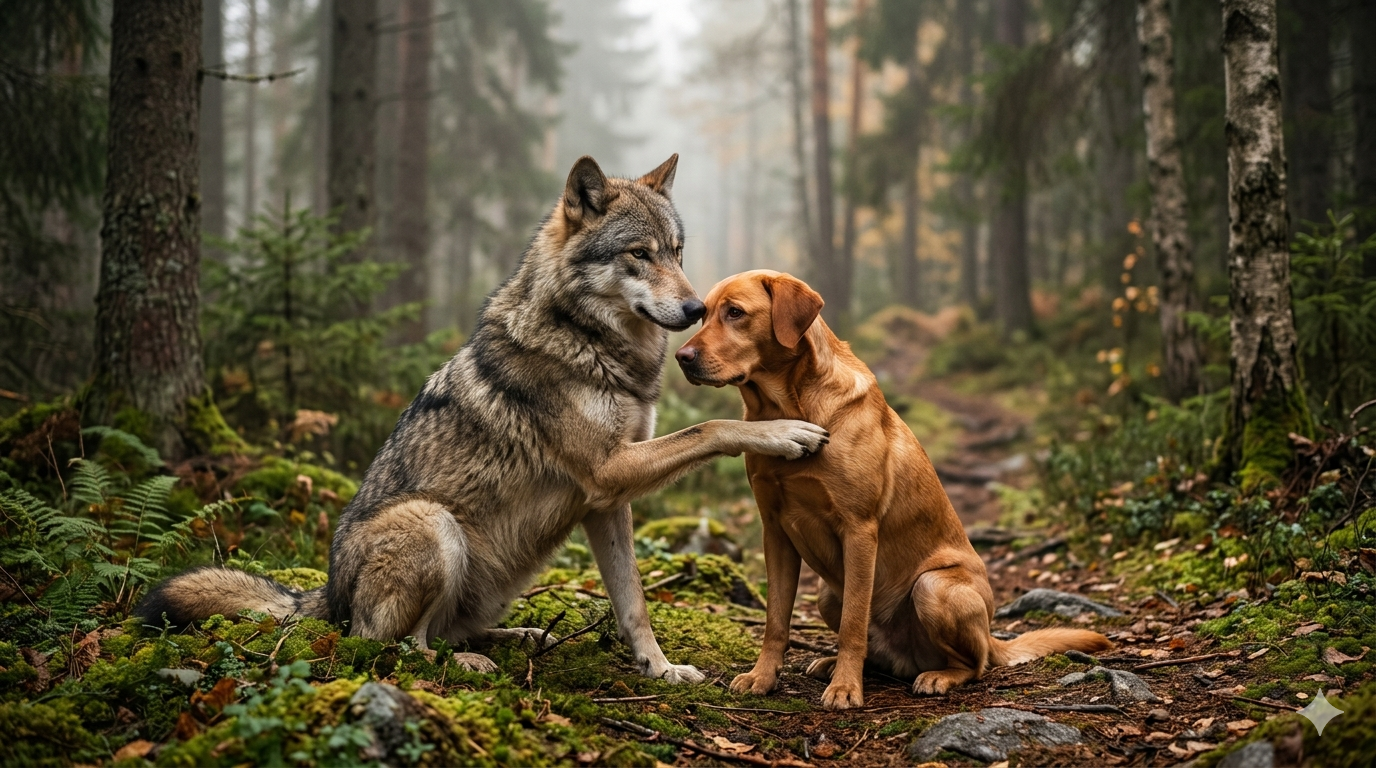
There is a substantial body of scientific evidence that suggests empathy and compassion are not exclusively human abilities. Researchers have observed, documented, and investigated the capabilities of empathetic responses and compassionate behaviors in various species (Karandashv, 2026, for a review).
In other articles in this Journal, I show why and how rodents and primates express empathy and compassion.
Now we are talking about how dogs and wolves express these manifestations of love to other peers, including their interactions and the social bonds they form within their packs.
These Are How Dogs and Wolves Express Empathy and Compassion
In canines, such as dogs and wolves, we can view empathy and compassion as a phylogenetic continuum, starting from basic emotional contagion (sharing the emotional state of another) to more complex perspective-taking (Silva & de Sousa, 2011). Among those evidence-based indicators of such feelings and actions are the following:
- Emotional Contagion & Mimicry, when dogs and wolves exhibit behavioral mimicry, such as contagious yawning or synchronized play movements (Madsen & Persson, 2012). During play, mimicry increases the duration of the interaction and is more common among closely bonded individuals, suggesting it reflects a synchronization of underlying positive emotions (Quervel-Chaumette et al., 2016).
- Response to Distress, when dogs exposed to whines from conspecifics, show increased physiological stress (higher cortisol) and behavioral alertness (Quervel-Chaumette et al., 2016). In such cases, they often provide “comfort-offering” behaviors, such as approaching and touching the distressed individual (Quervel-Chaumette et al., 2016).
- Prosocial Choices, when dogs in experimental “food-delivery” paradigms preferentially make prosocial choices (delivering food to a partner) for familiar conspecifics over strangers (Quervel-Chaumette et al., 2016).
- Cooperative Interactions, when wolves, as cooperative breeders, rely immensely on monitoring pack members to coordinate territory defense and hunting (Range & Virányi, 2014). Such behavior requires a high propensity to pay attention to the detailed actions of others. This trait may even exceed that of dogs in certain intraspecific tasks, such as coordinating group movements during a hunt or defending territory against intruders (Range & Virányi, 2014).
It Appears that Emotional Contagion Indicates Empathy in Dogs and Wolves
One of the most remarkable examples of empathetic behavior is emotional contagion. Dogs have been shown to engage in “emotional contagion,” a primary component of empathy where an individual mirrors the emotional state of another. When a human cries, dogs don’t just watch; they often mirror the distress.
When a dog hears a peer whimper or observes a feline companion in anguish, their physiological response frequently matches that of the victim. This is more than just a response to noise; it is a shared emotional experience. Research has indicated that dogs are more inclined to provide “consolatory behavior”—such as licking or physical contact—to people who have just undergone a stressful incident (Cools et al., 2011).
Studies show that dogs will approach a crying stranger with submissive, comforting behaviors (like nuzzling or licking) even when their own owner is present (Custance & Mayer, 2012). This indicates that their response isn’t just a “trick” to get treats from their owners but a genuine reaction to human suffering.
However, recent studies found that hand-raised wolves can also form deep attachments to specific humans, showing that the “hardware” for bonding with people was already present in the wild ancestor (Hansen Wheat et al., 2022). However, dogs have a unique “stress buffering” relationship with us. While a wolf might feel affection for a caretaker, a dog looks to a human as a secure base to navigate the world.
The differences are often in the way of their communication. Wolves tend to show empathy through precise pack coordination and food sharing. However, dogs can show empathy through gaze-tracking and responding to human “fear chemosignals” (Capitain, 2025). This ability allows them to better understand and react to their owners’ emotional states, fostering a stronger bond between dogs and humans involving empathy. It is likely that the wag of a tail or a gentle nuzzle toward a grieving companion isn’t just instinct—it’s a manifestation of empathy.
References
Capitain, S. (2025). Not just avoidance: Dogs show subtle individual differences in reacting to human fear chemosignals. Frontiers in Veterinary Science, 12, 1679991. https://doi.org/10.3389/fvets.2025.1679991
Cools, A. K. A., van Hout, A. J. M., & Nelissen, M. H. J. (2008). Canine consolation: Third-party affiliation in a group of domestic dogs (Canis familiaris). Ethology, 114(1), 53–63. https://doi.org/10.1111/j.1439-0310.2007.01453.x
Custance, D. M., & Mayer, J. (2012). Empathic-like responding by domestic dogs (Canis familiaris) to distress in humans: An exploratory study. Animal Cognition, 15(5), 851–859.
Hansen Wheat, C., Larsson, L., Berner, P., & Temrin, H. (2022). Human-directed attachment behavior in wolves suggests standing ancestral variation for human–dog attachment bonds. Ecology and Evolution, 12(9), e9299. https://doi.org/10.1002/ece3.9299
Karandashev, V. (2026). The Biological Evolution of Love. Springer Nature.
Quervel-Chaumette, M., Faerber, V., Faragó, T., Marshall-Pescini, S., & Range, F. (2016). Investigating Empathy-Like Responding to Conspecifics’ Distress in Pet Dogs. PLOS ONE, 11(3), e0152920. https://doi.org/10.1371/journal.pone.0152920
Range, F., & Virányi, Z. (2014). Wolves Are Better Imitators of Conspecifics than Dogs. PLoS ONE, 9(1), e86559. https://doi.org/10.1371/journal.pone.0086559
Silva, K., & de Sousa, L. (2011). ‘Canis empathicus’? A proposal on dogs’ capacity to empathize with humans. Biology Letters, 7(4), 489-492. https://doi.org/10.1098/rsbl.2011.0083