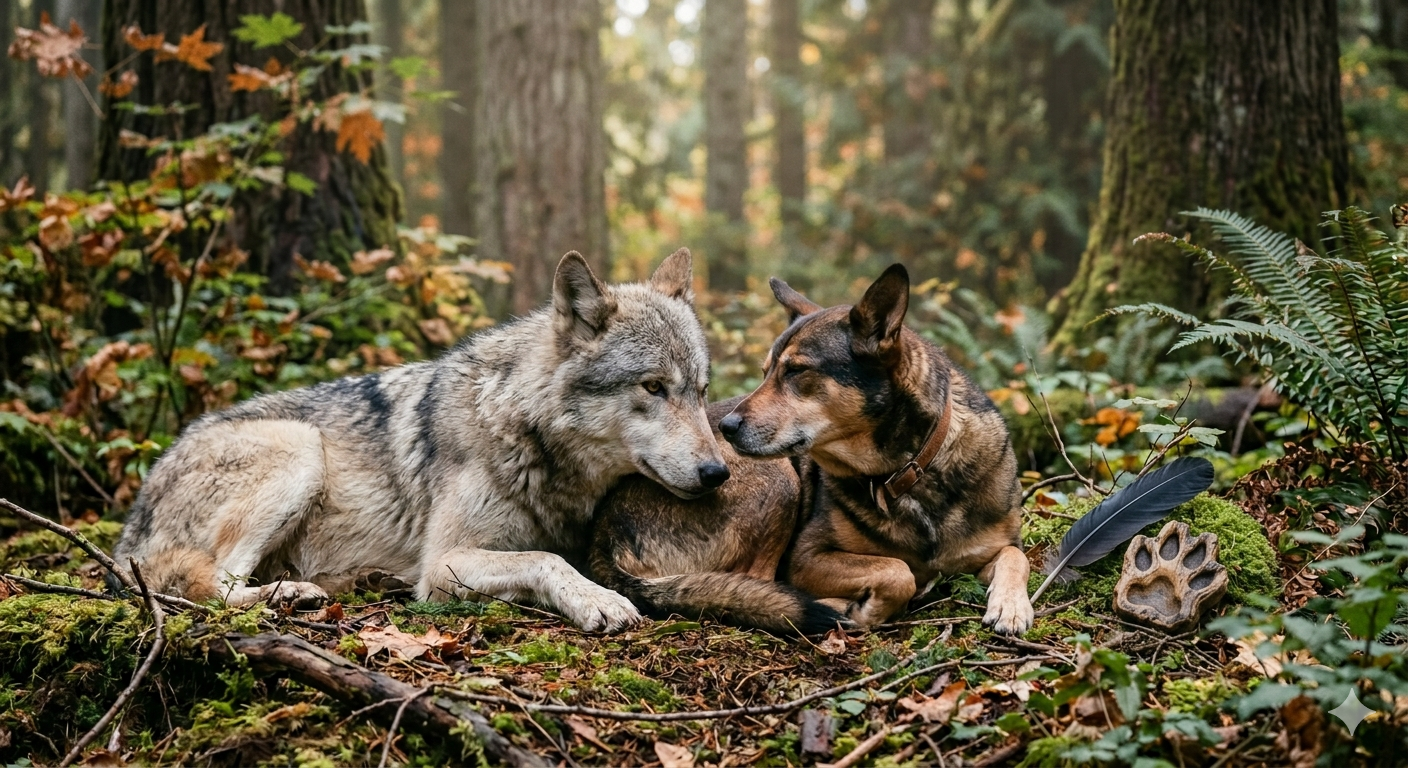
There is a substantial body of scientific evidence that suggests empathy and compassion are not exclusively human abilities. As we continue to explore the strengths of animals’ minds and emotions, we discover that their capacities for love are not simple reflexes. These are complex and multifaceted emotional states and behaviors that play an important evolutionary function, enhancing their capability to survive and thrive. Recognizing empathy and compassion in animals like rodents, dogs, and primates shows that these traits are fundamental to their connections within and across species. For instance, a dog can experience an empathetic emotional response and exhibit caring behavior, showing no difference in such behaviors between a pack member and a stranger in need. This can remind us that empathy and compassion are not human inventions but a biological path to a kinder world.
Researchers have explored the capabilities of empathetic responses and compassionate behaviors in various species (Karandashv, 2026, for a review). Other articles in the Diversity of Love Journal provide examples of cooperative behaviors, empathetic expressions, and prosocial actions that scientists observed in such animals as rats and mice and primates. This article is about empathy and compassion in dogs and their wild relatives—wolves.
Affective Empathy: How Dogs Recognize and Mirror Distress
Canine empathy involves more than just sharing joy; it also involves identifying the pain of another. Research on “affective empathy” indicates that dogs are able to distinguish between different kinds of cries. It’s interesting to note that dogs often react more strongly to the sound of a person or another dog crying than to sounds that are neutral or fake. This suggests an advanced understanding of the acoustic signals of distress (Cox et al., 2012; Custance & Mayer, 2012).
Such emotional sensitivity entails empathy in action—compassionate behavior. In cases when a Golden Retriever gently carries a stray kitten or a farm dog protects a weak lamb, these acts are not purely trained behaviors. These behaviors result from a biological evolutionary path that prioritized social cohesion and emotional connection.
Love Without Borders: Interspecies Altruism in Dogs
One of the most remarkable aspects of canine compassion is its lack of “speciesism.” Dogs frequently extend their empathetic reach to other animals, from cats and rabbits to livestock. This interspecies altruism is often driven by oxytocin, frequently dubbed the “love hormone.” When dogs interact positively with other animals, oxytocin levels rise in both parties, facilitating a sense of trust and social bonding (Marshall-Pescini et al., 2019).
In experimental settings, dogs have shown a willingness to provide food to familiar partners even when they gain no personal benefit for themselves. This demonstrates a form of pure compassion, suggesting that the act of helping a partner provides its own internal satisfaction as a reward in its own right. Such behavior shows evidence that for dogs, the well-being of a friend is a motivator powerful enough on its own. (Quervel-Chaumette et al., 2016). Such behavior is especially worth noting for its significance when observed between dogs and other species, indicating that the “diversity of love” among animals is regulated by a common biological language of love, which suggests that emotional connections can transcend species boundaries and highlight the importance of interspecies relationships.
Wolves Can Be Just as Kind as Dogs—and Sometimes Even More Prosocial
Folklore stories, particularly in Western European traditions, have commonly portrayed wolves as villains—the cold predators. However, recent studies from the Wolf Science Center have provided evidence that wolves are not as bad as they have been portrayed. They maintain deep social bonds in their pack—a highly social family unit, typically consisting of a breeding pair and their offspring from one or more years (Capitain et al., 2025).
Researchers from the Wolf Science Center have demonstrated that wolves can exhibit greater prosocial behavior—defined as intentional actions that benefit others—compared to dogs toward their own pack members (Dale et al., 2019).
In controlled experiments, wolves were more likely than dogs to provide food to a partner, especially if that partner was a member of their own social group. This suggests that the prosocial behavior of domesticated dogs isn’t necessarily a result of domestication. Their generosity, empathy, and compassion can be their ancestral traits rooted in their complex cooperation and emotional lives. Wolves rely on intense cooperation for hunting and pup-rearing, making empathy a survival necessity.
Wolves are capable of prosocial behavior, empathy, and compassion beyond food sharing. Research on contagious yawning, a known proxy for empathy, shows that wolves have a high level of emotional resonance. Romero et al. (2014) discovered that wolves yawn more frequently in reaction to individuals with whom they have a strong bond, implying a deep potential for “affective empathy.”
Furthermore, examinations of post-conflict behavior show that wolves engage in “bystander affiliation,” in which pack members soothe victims of aggression to relieve stress (Cools et al., 2010). Because wolves rely on strong collaboration for hunting and pup-rearing, empathy and compassion are more than social pleasures; they are survival necessities.
References
Capitain, S., Wirobski, G., Önsal, Ç., Pedretti, G., Bevilacqua, V., Marshall-Pescini, S., & Range, F. (2025). Differences in dogs’ and wolves’ human-directed greeting behaviour: facial expressions, body language, and the problem of human biases. Animal Cognition, 28(1), 54. https://doi.org/10.1007/s10071-025-01978-7
Cools, A. K., Van Hout, A. J., & Nelissen, M. H. (2010). Canine reconciliation and third-party-initiated postconflict affiliation: Do wolves share chimpanzee postconflict strategies? Behavioral Ecology and Sociobiology, 64(2), 265–273. https://doi.org/10.1007/s00265-009-0842-x
Cox, C. L., Uddin, L. Q., Di Martino, A., Castellanos, F. X., Milham, M. P., & Kelly, C. (2012). The balance between feeling and knowing: affective and cognitive empathy are reflected in the brain’s intrinsic functional dynamics. Social Cognitive and Affective Meuroscience, 7(6), 727-737.
Custance, D., & Mayer, J. (2012). Empathic-like responding by domestic dogs (Canis familiaris) to distress in humans: An exploratory study. Animal Cognition, 15(5), 851–859. https://doi.org/10.1007/s10071-012-0510-1
Dale, R., Palma-Jacinto, S., Marshall-Pescini, S., & Range, F. (2019). Wolves, but not dogs, are prosocial in a touch screen task. PLOS ONE, 14(5), e0215444. https://doi.org/10.1371/journal.pone.0215444
Marshall-Pescini, S., Schaebs, F. S., Gladewitz, A., Virányi, Z., & Range, F. (2019). The role of oxytocin in the dog–wolf–human continued evolution. Proceedings of the Royal Society B: Biological Sciences, 286(1910), 20191029. https://doi.org/10.1098/rspb.2019.1029
Quervel-Chaumette, M., Dale, R., Marshall-Pescini, S., & Range, F. (2016). Familiarity affects other-regarding preferences in pet dogs. Scientific Reports, 6(1), 33915. https://doi.org/10.1038/srep33915
Romero, T., Ito, M., Saito, A., & Hasegawa, T. (2014). Social modulation of contagious yawning in wolves. PLOS ONE, 9(8), e105963. https://doi.org/10.1371/journal.pone.0105963