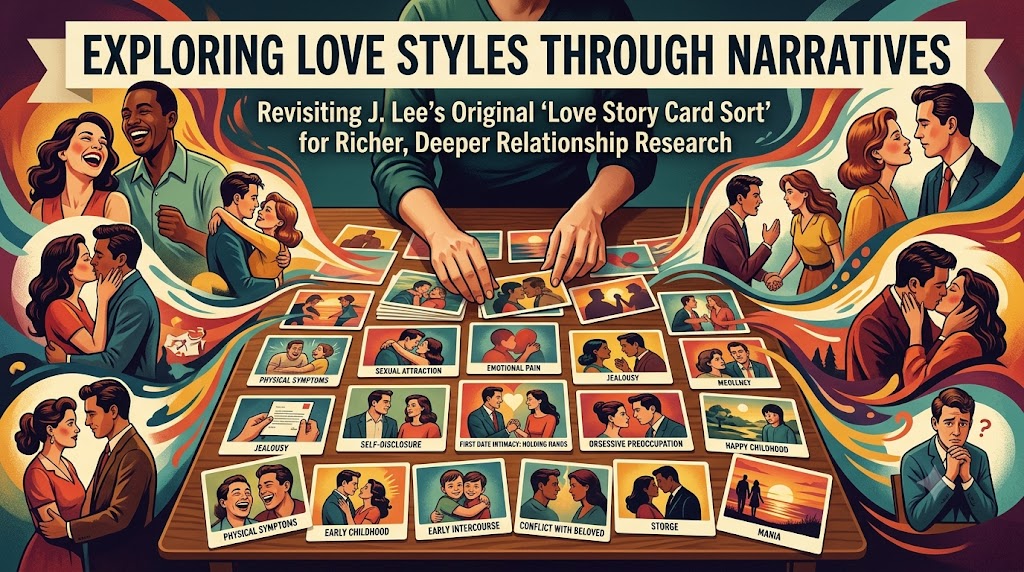
How John Alan Lee’s Card Interview Technique Can Restore Depth to Research on Love.
In the 1970s, sociologist John Alan Lee transformed relationship research with a groundbreaking, interactive “Love Story Card Sort.” Over the decades, however, his narrative method was flattened into quick, 1980s-era survey scales. This article explores how Lee originally built his theory of love styles—and why returning to his rich, story-driven approach offers a deeper path forward for contemporary research of love and relationships.
John Alan Lee’s Love Styles: Revisiting the Original Methodology
In the 1970s, a Canadian sociologist, John Alan Lee (1933–2013), developed the typology of love styles that attracted the attention of many love researchers (Lee, 1973, 1976). John Lee’s theory and method made important and original contributions to the study of love (Karandashev, 2022). Lee’s types were developed with modern scientific methods; the ancient Greek and Latin words he used were merely borrowed as convenient labels. While Lee’s original theory proposed twelve distinct types (with even more theoretically possible), usually only the six most common are listed in mainstream scholarly literature.
Love researchers immediately embraced this classification of love styles in their studies. Lee’s labels for love styles have been widely used since then. However, his theory and method are often misrepresented in modern publications. Contemporary researchers interpret these styles in ways that differ from how John Lee thought of them.
They largely used the Love Attitudes Scale (LAS), which Clyde and Susan Hendrick created during the 1980s to measure love styles. So, the theory and method of love styles, originally developed by John Lee, have been mainly known and used in this interpretation and measured with the LAS (Hendrick & Hendrick, 1986; Hendrick, Hendrick, and Dicke, 1998). The Love Attitudes Scale (LAS) has been a valid and reliable psychometric scale. However, it was a truncated version of the deeper and more complex method that Lee used in his research.
Looking Back to Lee’s Original Theory and Method
I believe it is worthwhile for modern love researchers to revisit the original version of the method. I think it would be a great idea to try using that original version of Lee’s method. This kind of research might give a richer and more complex picture of the love styles that people follow in their love relationships. My previous article presented what Lee’s original theory was. This article describes what his original method was.
This Is How John Lee Came to His Theory of Love Styles
An initial extensive analysis of literature allowed John Lee to develop the typology of love styles (Lee, 1973, 1976). Then, he administered a series of pilot empirical studies and explored their results with an extensive content analysis. A group of judges helped the author describe and check that the sets of valid, mutually exclusive, sufficiently complete, and important features of each of the different love styles were correct.
The descriptors and indicators he included in this content analysis were:
- physical symptoms involved in the lover’s experience of love (e.g., loss of appetite, sleep),
- sexual attraction,
- emotional pain,
- compulsive attention to the beloved,
- the willingness to abase, or alter the self to please the beloved,
- jealousy,
- self-disclosure,
- consciously manipulative behavior,
- the need for reciprocity, and others (Lee, 1973, p. 232).
The Method of “Love Story Card Sort”
In the main part of the study, Lee used the “Love Story Card Sort,” which was a method for measuring love styles developed by Lee himself for his initial research published in 1973. It serves as an interview method for a sensitive and coded systematic investigation of the love experience.
The card sort consists of about 1,500 cards, each of which describes some event, idea, or emotion possible in a romantic relationship. The cards are organized into 170 sets, each featuring a question card alongside a list of possible answer cards (including a blank write-in card). The card descriptions referred to the various facets of love:
- the experience and expression of feelings,
- the expectations of the beloved’s feelings and reciprocity,
- preoccupation with the beloved,
- the feelings of anxiety,
- anticipated troubles,
- the frequency and ways of contact with the beloved,
- the expectations about a love relationship,
- the frequency and matters of conflicts with the beloved, and so on.
Thus, using some features of both an interview and a questionnaire, a respondent is able to tell their own personal love story—happy or unhappy—with a very large total number of possible combinations. According to Lee’s description, “the whole sort comprises an omnibus love story, from which a respondent can select the relevant cards to tell his or her own story” (Lee, 1977, p. 176).
While an individual’s experience of love may appear to be unique, it is comprised of a collection of ideas, norms, and behavioral patterns that a culture encourages a person to follow. The modules of experience can combine with each other in a variety of ways. However, the love stories can only use a limited number of these modules and connect them in a limited number of ways. In this card sorting interview method, a person answered each question by choosing one from a set of cards that had possible answers. For instance:
“On our first date, the closest we got to being intimate was:
a) just being together, we never actually touched,
b) holding hands,
c) one good-night, or parting kiss,
d) kissing several times,
e) cuddling, holding each other close, embracing while clothed,
f) close body contact unclothed, without sexual intercourse,
g) we spent the night in the same bed but did not make love,
h) making love all the way,
i) other (specify).”
— (Lee, 1977, p. 176)
The Procedure and Analytical Reduction of the “Love Story Card Sort”
An interviewer shows the cards in succession. Participants choose the most suitable cards to illustrate the points in their narratives. Participants often feel their re-evoked emotions during the procedure. They may shed tears, laugh, experience nostalgia, or lament the events. The method allows a participant to reveal the emotional details of their experiences by dividing their complex experiences into discrete and recordable units. The interviewer records and categorizes the data. Based on the cards that participants choose, researchers construct or reconstruct a participant’s romantic relationship, which could be blissful, relaxed, hectic, or tragic.
To physically process and organize this vast amount of qualitative data, Lee used McBee edge-notched cards. Using McBee card sorting techniques, Lee reduced the massive pool of card sort items to just 206 cards that proved to be the most important factors for distinguishing the types of love in his sample. Among these, 32 cards emerged as particularly significant and predictive.
Examples mentioned by Lee as being among the most predictive include:
- Respondent believed his childhood was happy compared to that of his peers.
- He found his thoughts obsessively preoccupied with the beloved.
- He felt strong approval of the beloved’s looks at first sight.
- Sexual intercourse occurred very early in the relationship.
- Respondent accepted partner’s lack of intensity or holding back.
(John Alan Lee, Colours of Love: An Exploration of the Ways of Loving)
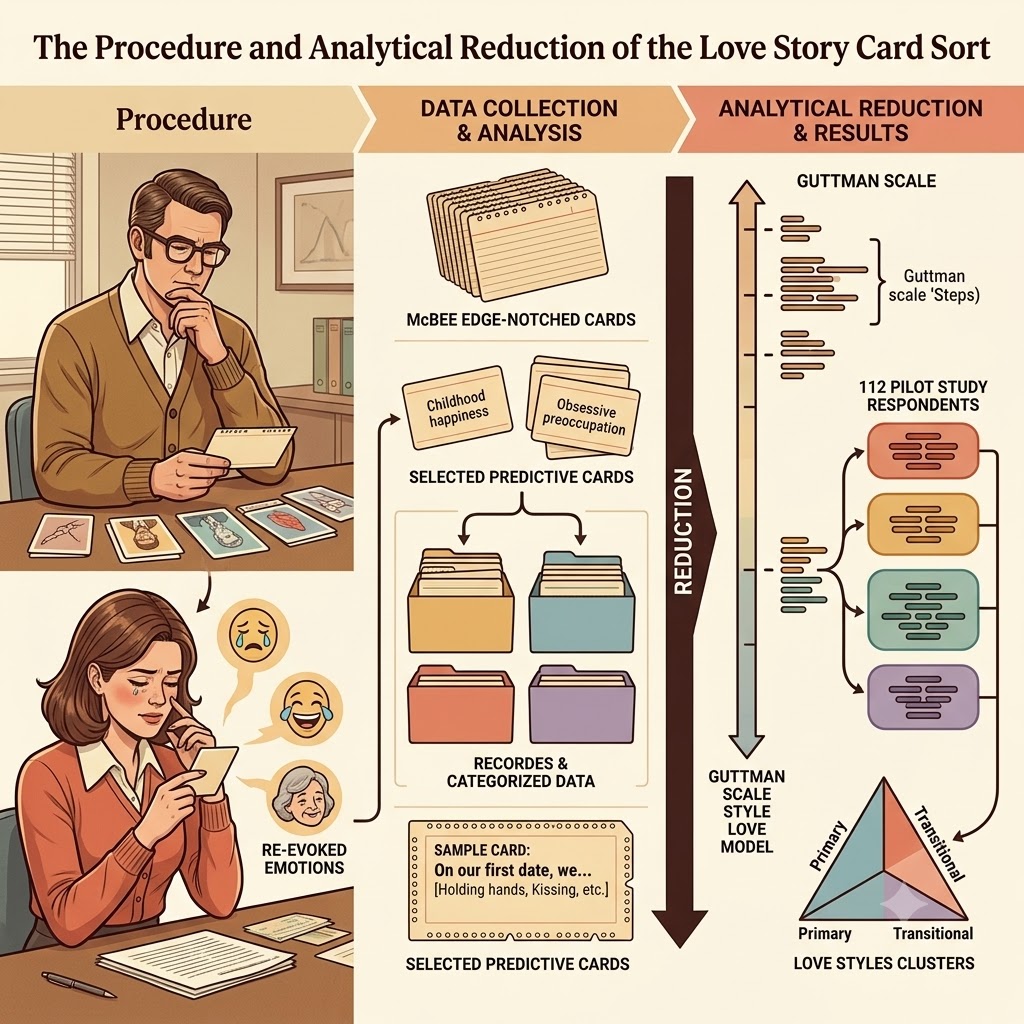
Figure 1. The step-by-step workflow of John Alan Lee’s card sorting procedure, data categorization using McBee cards, and Guttman scale reduction into love style clusters.
J. Lee then used a Guttman scaling technique to arrange his 112 pilot study respondents into distinct clusters, which corresponded to various love styles according to theoretical concerns. Some of these groups matched the classic love styles (eros, ludus, storge, and mania) as described in literature, while others appeared to be transitional (e.g., manic eros, manic ludus, storgic eros).
Because these transitional groups could not be arranged along a simple single continuum, Lee was led to develop his triangular model of three primary love styles. Ultimately, the factor analysis and Guttman scaling techniques allowed Lee to draw up a comprehensive profile of each love story as a distinct type, complete with its associated behavioral and emotional characteristics.
The Pros and Cons of the “Love Story Card Sort”
The “love story card sort” method is more flexible and adaptive for the in-depth study of love than a survey with a Likert-type scale. It gives a more comprehensive and complex typological description of the six love styles.
The Likert-type scale method, on the other hand, provides a more systematic and standard way of measuring love styles than an in-depth “card sort” interview. It allows for the identification of distinct patterns of love styles. An independent study on a large sample of participants used a Guttman-Lingoes Smallest Space Analysis. Its results revealed that six love styles are mutually exclusive (Lasswell, T. & Lasswell, M., 1976).
Conclusion: Bridging the Gap Between Measurement and Meaning
While standardized survey instruments like the Love Attitudes Scale (LAS) undoubtedly advanced the field by making love styles easy to measure across large demographic samples, something vital was lost in the transition away from Lee’s original method. By collapsing a comprehensive, interactive qualitative interview into static rating scales, modern research often measures attitudes about love rather than the full, dynamic processes of how people experience love and act in their relationships.
John Alan Lee’s “Love Story Card Sort” was far more than an early data-gathering exercise; it was a method designed to explore the multi-layered, emotional and behavioral reality of human feelings and relationships. Re-examining and adapting Lee’s original card-sort technique—especially in an era where digital tools can easily replicate the complex branching of his 1,500-card framework—presents an exciting frontier for contemporary researchers. By combining the rigorous classification of modern psychometrics with the narrative depth of Lee’s original vision, today’s researchers of love and relationship can move beyond simplified categories and capture a truly comprehensive picture of the way how people love.
References
- Hendrick, C., & Hendrick, S. (1986). A theory and method of love. Journal of Personality and Social Psychology, 50(2), 392–402.
- Hendrick, C., Hendrick, S. S., & Dicke, A. (1998). The love attitudes scale: Short form. Journal of Social and Personal Relationships, 15(2), 147-159.
- Karandashev, V. (2022). Cultural typologies of love. Springer Nature.
- Lasswell, T. E., & Lasswell, M. E. (1976). I love you but I’m not in love with you. Journal of Marital and Family Therapy, 2(3), 211-224.
- Lasswell, M., & Lobsenz, N. M. (1980). Styles of loving: Why you love the way you do. Doubleday.
- Lee, J. A. (1973). Colours of love: An exploration of the ways of loving. New Press.
- Lee, J. A. (1976). The colors of love. Prentice-Hall.
- Lee, J. A. (1977). A typology of styles of loving. Personality and Social Psychology Bulletin, 3(2), 173–182.