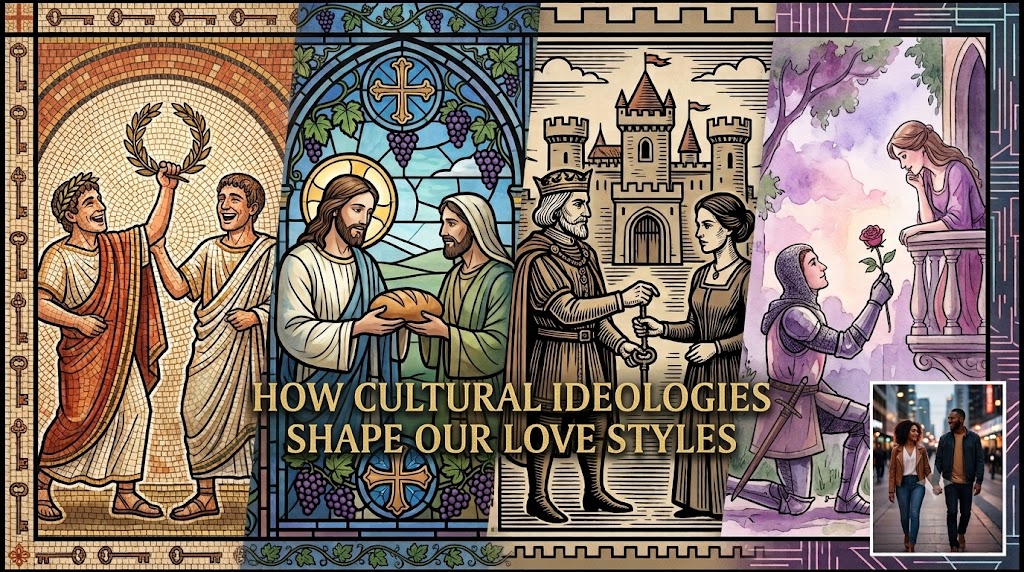
Why do we love the way we do? While contemporary psychology often treats love styles as individual traits, Canadian sociologist John Alan Lee recognized deeper roots of the way we love. It appears that our personal experiences of love are rooted in historical and cultural ideologies. This article explores how major cultural epochs—from the playful games of ancient Rome to the pragmatic structures of feudalism—shaped distinct frameworks of love, offering compelling cross-cultural perspectives to explain modern ways of how people love.
Different Love Styles in Cross-Cultural Perspective
During the 1970s, Canadian sociologist John Alan Lee introduced a groundbreaking framework exploring the diverse love styles that individuals enact within romantic relationships (Lee, 1973, 1976). This typological model remains a seminal contribution to the psychological and sociological categorization of intimate experiences (Karandashev, 2022). A concise overview of J. Lee’s theory is provided in another article in this journal.
Throughout the 1980s and 1990s, Lee’s theory of six primary love styles gained widespread recognition among relationship scholars. Numerous empirical studies adopted his typology to examine an array of individual variables associated with these styles, eventually expanding into cross-cultural comparative analyses (Karandashev, 2019).
I have provided a detailed description of each of these love styles in other articles, such as the Eros, Ludus, Storge, Agape, Mania, Pragma love styles.
Fewer scholars, however, recognize that Lee explicitly articulated the macro-level cultural ideologies underpinning these distinct orientations. In the conclusions of his foundational work, he argued that replicating his methodology through a comparative cross-cultural lens would yield vital sociological insights. The following overview synthesizes how Lee conceptualized the cultural ideologies behind these diverse expressions of intimacy.
The Socio-Cultural Frameworks and Ideologies of Love
Lee posited that the preferred cultural and behavioral patterns associated with distinct love styles do not emerge in isolation; rather, they evolve over time into socially sanctioned systems of thought. These overarching cultural ideologies are deeply shaped by the prevailing social institutions, economic realities, and philosophical movements of a given era. Consequently, the shifting social conditions of a specific historical period can elevate a particular framework of love into the cultural norm, turning an individual experience into a collective ideology of love style (Lee, 1975). To understand how deeply modern love is anchored in history, one must examine how previous civilizations systematically cultivated these models of love.
Here are some examples.
The Roman Cultural Ideology of Love: Ludus as a Game of Love
The cultural ideology in the historical period of ancient Roman civilization was open and permissible to a variety of sex and love. The Roman culture was conducive to the art of love and seduction rather than to genuine love feelings. The cultural ideology of the time encouraged love more as a playful adventure and a game. The principles underlying entertainment, play, and games determined people’s experiences of love and expressions. This is why the Ludus love style was popular in the cultural climate of that time.
The Christian Ideology of Love: Agape as Altruistic Devotion
The Christian ideology that prevailed during the early centuries of the Christian era opposed the Ludus love ideology. Different from this, Christian religious teachings emphasized the importance of the Agape love philosophy. The Agape love cultural ideology served as the foundation for Christian conceptions of religious beliefs, practices, and marriages. According to this ideology, love should adhere to the ideals of selflessness, generosity, and concern for others.
The Feudal Cultural Ideology of Love: Pragma as a Rational Alliance
The feudal societies were highly structured and had a high-power distance between people of different social classes. People believed that the cultural ideology of hierarchical societies fits into the reality principle of life. Many traditional collectivistic societies have been organized this way.
This feudal cultural ideology developed into a pragmatic love ideology. The Pragma love style was well suited to that social organization. And the institution of arranged marriage became very common in these societies.
The Cultural Ideology of Courtly Love: Mania as Obsessive Devotion
Since the 12th century, a cultural ideology of courtly love has evolved in several European societies. The adventurous pleasure principle of this love style opposed the Christian ideology of the Agape love style as duty love. It also opposed the Feudal ideology of the Pragma style of love and arranged marriage.
The social conditions of life among medieval knights and aristocracy in the south of France, Spain, Italy, and Germany were well suited to the new adventurous style of love relationships. In the centuries that followed, it developed further into what we now know as romantic love or Mania love style.
Thus, we can see that the cultural and intellectual atmosphere of certain epochs has been more favorable to one of them than to another. Throughout history, various cultures have promoted certain ideologies of love as the ideal model.
Individual Variations of Love Styles Within a Culture
In any historical or modern culture, men and women vary in their typological differences and in the personal experience of relationships they have. Therefore, each of these different love styles has existed in all historical eras. And each of these different love styles is present in a wide variety of modern cultures.
The way a person loves and the things that come with it may depend on their personality, the personality of their partner, and their relationships. The person can act in ways that are typical of different love styles in different situations and contexts of their life. She or he can change their love style in the different stages of their relationship. For example, Mania and Eros love styles tend to be more common among young men and women, while Storge love styles tend to show up later in a relationship (Karandashev, 2019).
Prospective Applications of Lee’s Methodology Across Cultures
While the original sociological methodology developed by Lee remains highly applicable to international research (Lee, 1975), cross-cultural investigations adhering strictly to his holistic approach are surprisingly sparse.
For decades, international research focusing on love styles has predominantly evaluated cross-cultural differences through the narrow lens of love attitudes (see Karandashev, 2019, for a comprehensive review). However, within Lee’s theoretical architecture, a clear conceptual distinction must be maintained between a love attitude and a love style (Lee, 1973, 1975, 1976, 1977).
Love attitudes represent merely singular—albeit significant—cognitive components of a personal orientation in love. In contrast, love styles are multifaceted, complex phenomena that comprehensively encompass emotional experiences, expressions, behavioral actions, and structural dynamics within a relationship.
The exact research methodology that Lee developed could yield profound insights if applied systematically to other cultures (1975). However, to date, few researchers have conducted comprehensive cultural studies utilizing this complete typological method. This would be a great idea for modern researchers of love to advance these theoretical conceptions.
References
- Karandashev, V. (2017). Romantic love in cultural contexts. Springer.
- Karandashev, V. (2019). Cross-cultural perspectives on the experience and expression of love. Springer.
- Lee, J. L. (1973). The colors of love: The exploration of the ways of loving. Ontario, Canada: New Press.
- Lee, J. A. (1975). The romantic heresy. Canadian Review of Sociology/Revue canadienne de sociologie, 12(4), 514-528.
- Lee, J. (1976). The colors of love. Prentice-Hall.
- Lee, J. A. (1977). A typology of styles of loving. Personality and Social Psychology Bulletin, 3(2), 173-182.