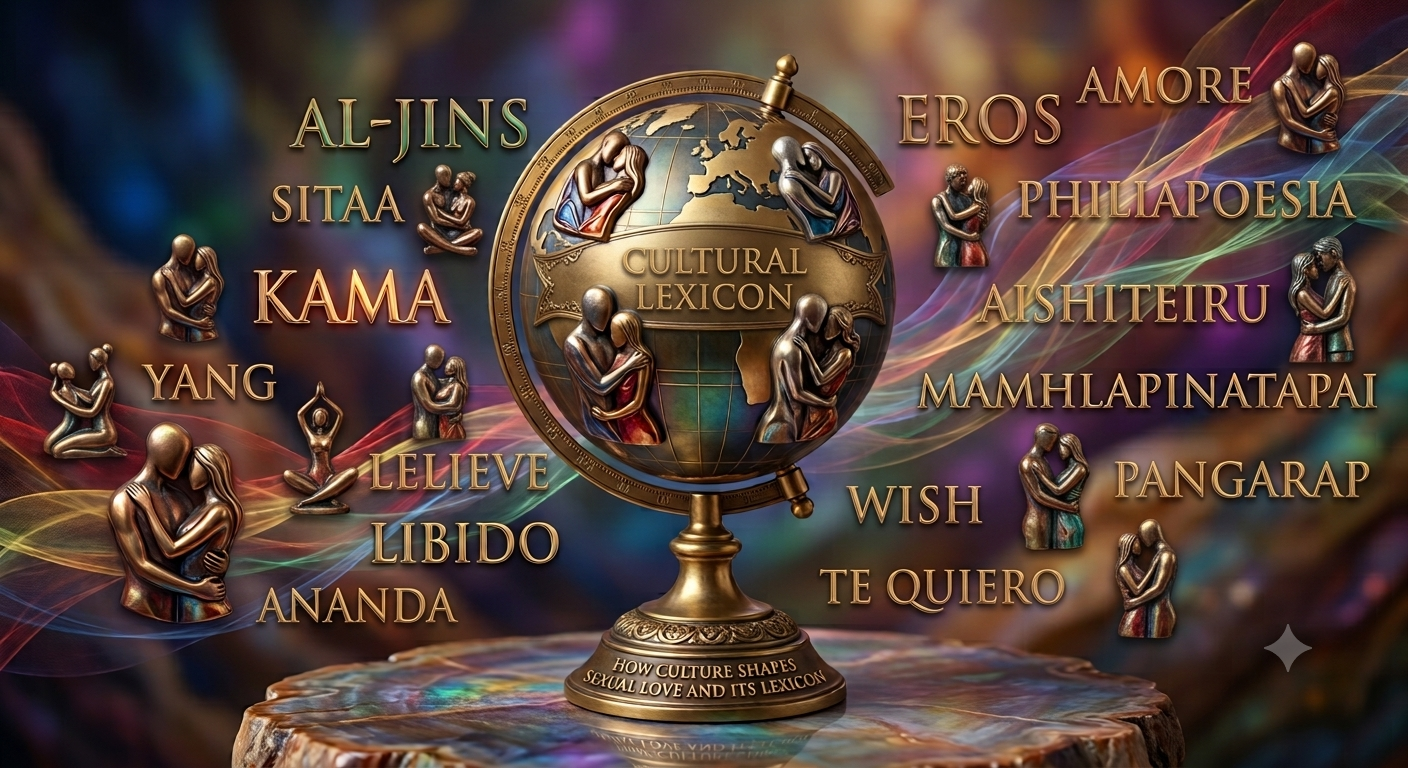
Is sexual desire a universal biological drive or merely a cultural construct? Although the evolutionary biology of human sexual desire is substantially similar, the linguistic and psychological frameworks people use to understand sexual attraction and desire vary significantly. This article explores cross-cultural variations, cultural lexicon, and the distinct interpretations of “sexual love” throughout classical Western history, in Arabic linguistics, and among indigenous cultures around the world.
Giving Words to the Senses
Imagine a language that has a word or phrase for that breathless, quiet moment when two individuals look across a room, each longing to reach out, but neither dares to say. This was named mamihlapinatapai by the Yagán people of the frozen terrain of Tierra del Fuego. Halfway across the world in the tropical warmth of the Philippines, a sudden rush of amorous and sexual energy is named as kilig.
The biological motivation behind these sentiments is comparable from typical evolutionary biology, but the psychological vessels people make to house them are drastically different. People typically lump sex, eroticism and physical intimacy together into one psychological container. But in isolating sexual love from other senses and feelings we see that the manner in which people experience sexual desire is significantly impacted by the place and culture where they live. In this article, I review the cultural dimensions of sexual love across times, languages and places.
More Than a Feeling: What Makes Sexual Love Unique?
Many scholars and laypeople conflate the notions of physical sex, sexual love, and erotic love (eros). However, cross-cultural psychological research suggests the need to distinguish between these concepts because they present fundamentally distinct domains of human experience (Karandashev, 2022). While physical sex can be purely mechanistic, and erotic love often incorporates idealized romanticism, sexual love occupies a distinct psychological space characterized by the following:
- Intense somatic desire: Acute states of physical longing, aesthetic interest, and deep behavioral attraction.
- A dedicated affective spectrum: A unique cluster of sexual emotions, vulnerability, and specific neurochemical states of attachment.
- The relational act: Various physical and communicative acts between individuals that transcend simple biological release.
Since sexual love is rooted in human evolutionary biology, it seems to be cross-culturally universal. Every human society recognizes its pull. Nevertheless, its personal framing is culturally specific. People experience sexual desire in complexity; individuals interpret, judge, and express sexual love through the specific vocabulary, moral frameworks, and historical lineages of their respective societies.
What Does “Coitus” Mean for Sexual Love?
To understand the Western tradition’s view of the climax of sexual love, we must look at the etymology of the word “coitus.” The Latin roots (coire) mean, literally, ” a coming together ” or ” meeting. This etymological origin reveals that the more important cultural significance of coitus is more than just mechanical physical satisfaction or simple friction of anatomy.
Historically and psychologically, for both men and women, the interpersonal physical intimacy of intercourse is more emotionally profound than the solitary intensity of masturbation. In the seminal sociological studies of human sexuality, Shere Hite (1976/2004, 1981/1987) collected extensive qualitative testimony that people place a high value on the relational component of coitus. The act serves as a primary way for sexual love because it represents a literal and figurative collapse of boundaries between the self and the other, transforming a biological imperative into an act of mutual recognition.
The Greek and Latin Origins of the Western Lexicon for Sexual Love
The contemporary Western lexicon of desire is heavily indebted to classical antiquity. Historically, the Western framework of desire diverged into two primary linguistic and conceptual pathways:
- The Latin Tradition (Libido): Conveyed an emphasis on yearning, longing, and an intense desire for individual, sensual self-fulfillment.
- The Greek Tradition (Epithymia): Characterized a visceral, appetitive hunger focused on physical closeness and union with a partner.
The meanings of both terms include the somatic pleasure of the body and the gratifying release of accumulated sexual energy. Within this specific paradigm, other emotional dimensions of love—such as spiritual devotion (agape) or deep companionate friendship (philia)—are of secondary importance (Casertano, 2022; Kahn, 1987; Tillich, 1954; Lorenz, 2006). The focus remains squarely on the visceral, embodied experience of attraction.
What Does the Greek “Epithymia” Mean?
The term epithymia refers to “the longing for coitus, the hungering and thirsting for sexual closeness and union with a partner” (Karandashev, 2022). It represents the appetitive aspect of human nature. However, it should not be misunderstood as a purely animalistic drive.
In the context of sexual love, general physical attraction to a partner is essential, but the lover centers their emotions not only on the partner’s body but also on the person as a whole. Consequently, epithymia ensures that coitus yields a dual dividend: it satisfies a physical hunger while simultaneously providing deep emotional validation and security (Casertano, 2022; Kahn, 1987; Lomas, 2018; Lorenz, 2006; Tillich, 1954).
Cross-Cultural Parallelisms and Divergences in the Meaning of Sexual Love
Many cultures express the concept of sexual love in ways that mirror Greek epithymia, proving that the integration of physical longing and emotional intimacy is a global phenomenon. Even seemingly distinct language groups frequently have profound structural and historical connections.
The Arabic Origins of the Sexual Lexicon
Professor of Linguistics Zaidan Ali Jassem (2013) proposed that many foundational “love and sexual terms” in English, French, German, Greek, and Latin possess historical linkages to Arabic origins through systematic phonetic shifts.
“English, French, Greek and Latin erotic (Eros) comes from Arabic ‘arr ‘intercourse, making love’; English, French, and Latin abhor obtains from Arabic kariha/’akrah, kurh (n) ‘hate’ via /k & h/-merger; English and German love/lieben derives from Arabic labba (‘alabba) ‘to love, live/stay’, turning /b/ into /v/; English hope (hobby) and German hoffen is from Arabic 2ubb ‘love, hope’, turning /2/ into /h/ and /b/ into /f/ in the latter”.
(Jassem, 2013, p. 97).
In modern Arabic societies, terms for sex and sexual love are clearly delineated as الجنس (al-jins) and الحب الجنسي (al-hubb al-jinsi), balances that isolate the physical act from the emotional infatuation that accompanies it.
Cultural Variations in the Idioms of Sexual Desire
When we look beyond Western and Middle Eastern paradigms, we find highly nuanced lexical tools used to describe the somatic and psychological realities of sexual love. Here are several other examples from other cultures around the world.
| Culture / Language | Term | Core Psychological Meaning |
| Philippines (Tagalog) | Kilig | The visceral, shivering feeling of “butterflies in the stomach” when interacting with a sexually attractive individual. |
| Yagán (Tierra del Fuego) | Mamihlapinatapai | A silent, expressive look shared by two people who both desire physical intimacy, yet are reluctant to initiate. |
| Sanskrit / Hindu Tradition | Kama | The philosophical and sensual pursuit of sexual love, pleasure, and aesthetic enjoyment as a legitimate goal of human life (Vātsyāyana, 3rd century CE/2009). |
| Traditional Chinese | Huo Yin Yang | Literally the “union of Yin and Yang,” a traditional framework mapping sexual love as the harmonization of male and female forces (Ruan, 1991; Ruan & Lau, 1997). |
| Japanese | Hore-gusu | A unique historical conceptualization linking intense sexual infatuation with a physical, almost medicinal psychological state (Shirane, 2002/2008). |
| Indigenous Americas | Varied Lexicons | Distinct terminology separating reproductive mechanics from the sacred or affective experience of passionate sexual union. |
As American ethnologist Daniel Brinton (1886) observed in his early surveys of indigenous American languages, many native societies developed complex, highly specialized vocabularies for sexual love. These terms stood completely apart from the words used for basic anatomical procreation or non-sexual companionate love, demonstrating an ancient, sophisticated understanding of sexual love as an independent psychological domain.
In Asian structural philosophies, we observe an identical tendency to embed sexual love into wider relational balances rather than separating it entirely as raw biological lust. For instance, traditional Chinese frameworks utilize the principles of Yin (the female force) and Yang (the male force) to conceptualize physical union. Expressions like He Yin Yang (the blending of Yin and Yang) explicitly frame sexual intercourse not merely as physical release, but as a holistic, necessary harmonization of complementary cosmic and physical energies within a partnership (Ruan, 1991; Ruan & Lau, 1997). Similarly, the ancient Indian classical text, the Kama Sutra, elevates Kama (desire, sensual pleasure) to one of the four essential pillars of human life, treating sexual love as an art, a psychological discipline, and a vehicle for mutual emotional cultivation (Vātsyāyana, 3rd century CE/2009).
Bridging Biology and Culture: Translating Sexual Love Across Cultures
Ultimately, sexual love reveals itself as a complex interplay between biological unity and cultural diversity. The physiological furnace—the rushing neurochemicals, the elevated heart rate, the drive toward somatic union—remains a constant across human history. Yet, as we have seen, the vocabulary we use to navigate this furnace changes dramatically across cultures. Whether expressed through the classical lens of Greek epithymia, the emotional resonance of Latin coitus, or the highly specific idioms of East Asian and indigenous languages, humanity continually seeks to elevate raw physical desire into a meaningful relational experience. By studying these cultural variations, scholars can move past narrow, ethnocentric definitions and build a richer, more universal understanding of human intimacy.
References
- Brinton, D. G. (1886). The conception of love in some American languages. Press of McCalla & Stavely.
- Casertano, G. (2022). Logistikon, thymos and epithymia before Plato. Archai, 32, Article e03231. https://doi.org/10.14195/1984-249X_32_31
- Hite, S. (2004). The Hite report: A nationwide study of female sexuality. Seven Stories Press. (Original work published 1976)
- Hite, S. (1987). The Hite report on male sexuality. Alfred A. Knopf. (Original work published 1981)
- Jassem, Z. A. (2013). The Arabic Origins of “Love and Sexual Terms” in English and European Languages: A Lexical Root Theory Approach. International Journal of Language and Linguistics 1(4):97. DOI:10.11648/j.ijll.20130104.13
- Kahn, C. H. (1987). Plato’s theory of desire. The Review of Metaphysics, 41(1), 77–103.
- Karandashev, V. (2022). Cultural typologies of love. Springer Nature.
- Lomas, T. (2018). The flavours of love: A cross‐cultural lexical analysis. Journal for the Theory of Social Behaviour, 48(1), 134-152.
- Lorenz, H. (2006). The brute within: appetitive desire in Plato and Aristotle. Oxford University Press.
- Ruan, F. F. (1991). Sex in China: Studies in sexology in Chinese culture. Springer.
- Ruan, F. F., & Lau, M. P. (1997). China. In R. T. Francoeur (Ed.), The international encyclopedia of sexuality (Vol. 1, pp. 331–379). Greenwood Press.
- Shirane, H. (Ed.). (2002/2008). Early Modern Japanese Literature: An Anthology, 1600-1900 (Abridged Edition). Columbia University Press.
- Tillich, P. (1954). Love, power, and justice: Ontological analyses and ethical applications. Oxford University Press.
- Vātsyāyana. (2009). The Kama Sutra of Vatsyayana (R. Burton, Trans.). Oxford University Press. (Original work published c. 3rd century CE)