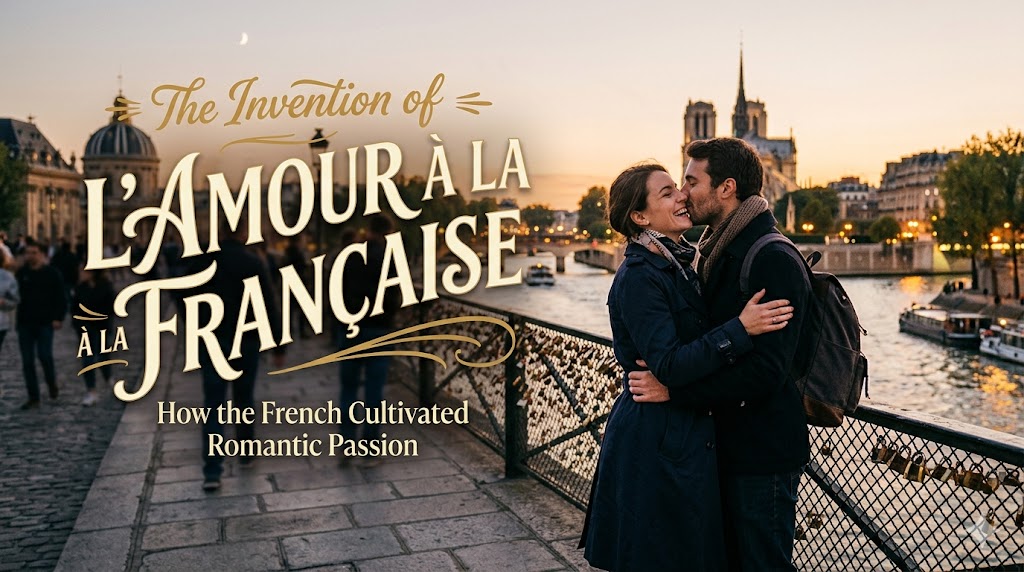
Passion might be hardwired into our biology, but how we love is entirely learned from culture. Here is the true story of how French culture “invented” modern romantic love—L’Amour à la Française—and its lexicon, like rendezvous, tête-à-tête, amour fou, and ménage à trois.
The French developed a culturally new way to experience love and express it. Tracing history back to the 12th-century courts of powerful noblewomen, this article shows how the rules of “courtly love” inverted patriarchal norms, putting women in charge and declaring that passion mattered more than social or religious rules (Karandashev, 2015; 2017; 2022).
Based on the letters of 18th-century salon muses and modern cross-cultural surveys, this article reveals why the French culture views jealousy and extramarital passion, presumably condemnable sides of love, as normal human nature rather than moral failures (Yalom, 2012).
Cultivating Passion: How the French Turned Sexual Desire into Love
How do cultural values and traditional behaviors influence the subjective experience, emotional expressions, and social models of love? While passionate love possesses universal, biological elements rooted in sexual desire, culture is the essential mechanism that transforms raw passion into structured romantic concepts (Karandashev, 2015, 2017; 2022). Different cultures develop distinct mentalités—specific frameworks of ideas, attitudes, and emotional expectations that dictate how love is practiced, understood, and communicated (Yalom, 2012).
In Western history, French culture stands out as a unique paradigm where love was systematically cultured and cultivated from the Middle Ages onward until it became l’amour à la française—a distinct reason for national pride. This cultural model integrates linguistic nuances, behavioral codes, and distinct psychological dynamics that differ sharply from other Western perspectives, such as tighter-laced Anglo-American models (Yalom, 2012).
Language as a Cultural Blueprint for French Love
Language serves as a vital repository for a society’s model of love, as the lexicons a culture creates—or that other cultures adopt—reveal its underlying emotional experiences (Karandashev, 2015; 2017; 2022). An American feminist author and historian, Marilyn Yalom (1932–2019), documented that English speakers frequently borrowed French expressions to capture specific nuances of romantic and sexual love (Yalom, 2012).
Terms like rendezvous, tête-à-tête, and ménage à trois are widely used globally to denote distinct physical and social spaces of romantic love. Concepts of behavioral refinement, such as courtesy and gallantry, trace their origins directly back to French historical models of love. Furthermore, emotionally charged expressions like risqué, raffiné, amour fou, and femme fatale highlight a cultural taxonomy that explicitly labels the complex, unconventional, and highly intense dimensions of human desire (Yalom, 2012).
Taming the Knight: How Medieval Women Flipped the Rules of Love
The historical evolution of l’amour à la française demonstrates how social shifts in gender power dynamics redefined a culture’s romantic blueprint. In the 12th century, the court of Marie de Champagne became a focal point for the formalization of fin’amor, or refined courtly love. This period introduced a profound paradigm shift by taming and training warrior-men to become elegant, respectful suitors, elevating the woman to a superior position of worship (Karandashev, 2017; Yalom, 2012).
As codified in Andreas Capellanus’s historical text The Art of Courtly Love (De arte honeste amandi), lovers were declared equal in all regards, while the knight was expected to submit to the lady’s will (Capellanus, c. 1184/1941). Crucially, the sentiments between husbands and wives could never qualify for fin’amor; thus, courtly love operated outside the institution of marriage (Karandashev, 2017; Yalom, 2012).
This model established a familiar triad—the husband, the wife, and her lover—which represented a fascinating reversal of the traditional patriarchal configuration consisting of a husband, his wife, and his maîtresse. This historical framework prioritized intense passion over social conventions, family ties, and religious dictates, heavily emphasizing mutual consideration by instructing lovers never to exceed the physical desire of their partners. Over subsequent centuries, these foundational concepts had a lasting impact on French culture, evolving through distinct variations of gallantry, libertinage, and romanticism (Yalom, 2012).
Erotic Connotations in the French vs. American Cultural Models of Love
Cross-cultural comparisons reveal stark differences in how nations overlay moral judgments onto romantic experience and behavior (Karandashev, 2017; 2022). Empirical observations point to distinct differences between French and American romantic models:
- No Passion, No Love? — Sexual Pleasure and True Love. In cross-cultural surveys examining whether true love can exist without a radiant sex life, a massive statistical divergence emerges. While 83 percent of Americans surveyed agreed that true love could exist without a vibrant sexual relationship, only 34 percent of French respondents agreed, highlighting a cultural model where carnal satisfaction is viewed as an essential ingredient of love.
- The Right to Passion: Why French Love Integrates the Affair. Unlike Anglo-American models that often view relational disruptions through a rigid moral lens, the French cultural model accepts that sexual passion has its own justification. Darker emotional realities—such as jealousy, suffering, extramarital relationships, multiple lovers, and disillusionment—are integrated into the French framework as normal features of passion rather than relational failures).
L’Amour à la Française – The Enduring Culture of French Desire
The cultural model of l’amour à la française illustrates how a society can systematically weave romantic and sexual discourse into the fabric of everyday life, literature, and national identity. From historical configurations of polyamory—such as the letters of 18th-century muse Julie de l’Espinasse or the lifestyle of 19th-century writer George Sand—to modern attitudes, French culture maintains a high level of comfort with the complexities of desire. Ultimately, this model operates on a continuous eroticization of language and social interactions, demonstrating that while the specific social expressions of love may vary across epochs, the foundational cultural framework remains remarkably enduring (Karandashev, 2015; Yalom, 2012).
References
Capellanus, A. (1941). The art of courtly love (J. J. Parry, Trans.). Columbia University Press. (Original work written c. 1184).
Karandashev, V. (2015). A cultural perspective on romantic love. Online Readings in Psychology and Culture, 5(4), 1–21. https://doi.org/10.9707/2307-0919.1135
Karandashev, V. (2017). Romantic Love in Cultural Contexts. Springer.
Karandashev, V. (2022). Cultural typologies of love. Springer.
Yalom, M. (2012). How the French invented love: Nine hundred years of passion and romance. HarperCollins.