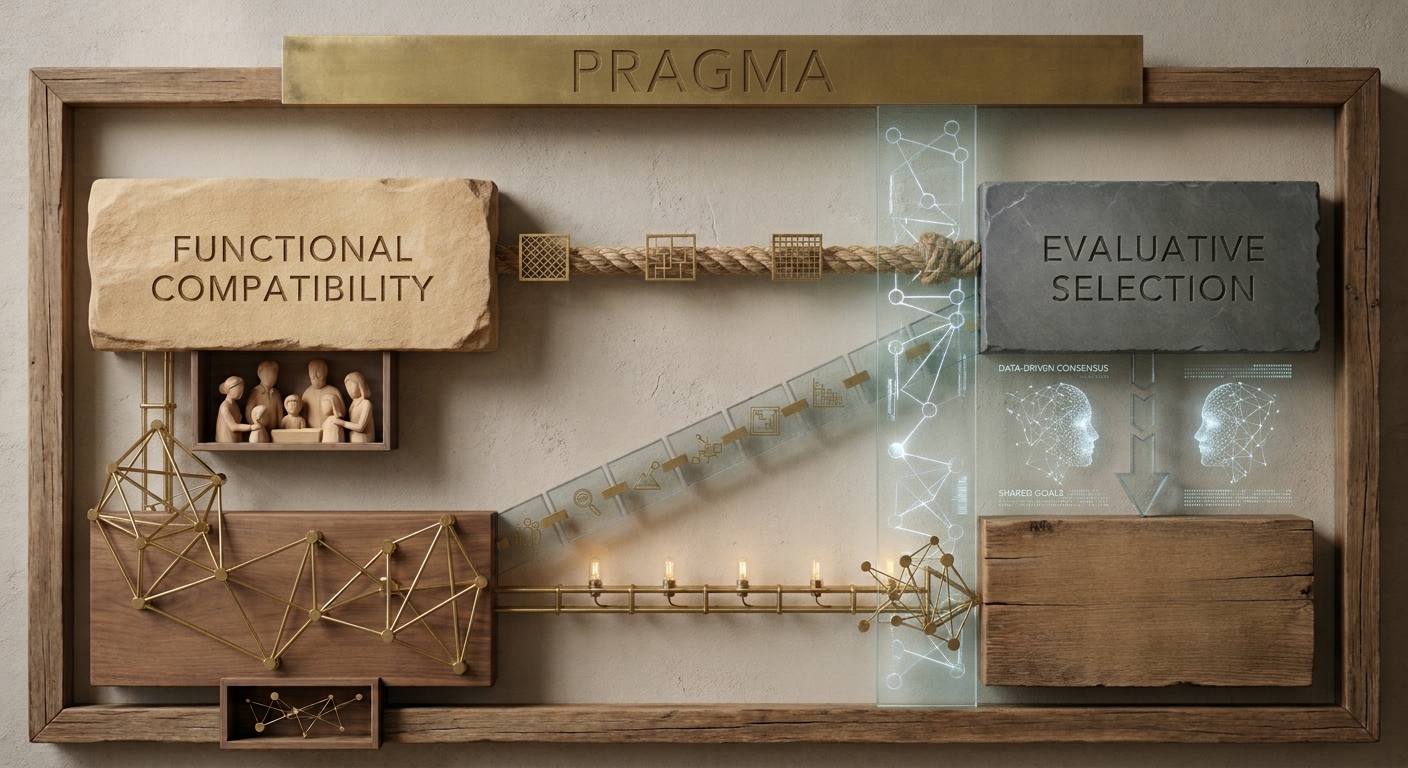
Western romantic narrative traditions frequently favors the immediate, affective surge of Eros or the mysterious, subcortical appraisals of “love at first sight.” However, relationship science demonstrates that romantic bond formation can follow a fundamentally different cognitive trajectory. Rather than viewing romantic attraction as an unaccountable emotional lightning bolt, the Pragma path approaches relationship formation as a deliberate, evaluative process grounded in rational compatibility, shared goals, and conscious selection (Lee, 1973; Hendrick & Hendrick, 1986).
In John Alan Lee’s (1973, 1977) seminal typology of love styles, Pragma is conceptualized as a compound secondary style—a synthesis of companionate affection (Storge) and conscious, deliberate boundary control (Ludus). Rather than operating as an unfeeling or opportunistic transaction, Pragma represents a sophisticated cognitive strategy: choosing a partner with reason, evaluating life alignment, and allowing emotional intimacy and enduring commitment to flourish upon a stable, functional foundation (Karandashev, 2019, 2022).
1. Theoretical Foundations: Lee’s Pragma and Evaluative Cognitive Frameworks
John Alan Lee’s (1973, 1977) original theoretical taxonomy posited that romantic orientations could be categorized into primary styles (Eros, Ludus, Storge) and secondary compounds (Mania, Pragma, Agape). Pragma emerges when the slow, trust-building companionate orientation of Storge combines with the controlled, goal-directed, and emotionally regulated approach of Ludus (Lee, 1977).
Unlike the purely ludic individual who maintains emotional detachment for independence or novelty, the pragmatic lover utilizes cognitive control toward a constructive, long-term objective: building a durable, functionally harmonious life project (Arnold & Thompson, 1996; Guerrero & Bachman, 2006; Guerrero et al., 2020).
Pragmatic lovers approach mate selection not through spontaneous surrender to limerence, but through what psychological research conceptualizes as evaluative selection (Dion & Dion, 1973; Hendrick & Hendrick, 1986). They maintain clear, explicit criteria regarding lifestyle compatibility, financial habits, educational background, family orientation, and emotional regulation. In this framework, reason does not oppose love; rather, reason serves as the necessary gatekeeper that creates a safe, predictable environment in which emotional connection can safely deepen without the threat of structural incompatibility (Karandashev, 2019).
2. The Cognitive Psychology of Rational Compatibility
From a neurocognitive perspective, while immediate romantic passion relies heavily on subcortical reward pathways and dopamine-driven incentive salience, the Pragma path engages executive networks within the prefrontal cortex. Pragmatic evaluation involves active working memory, future-oriented planning, and prospective decision-making (Karandashev, 2022).
When an individual engages in pragmatic mate selection, several key cognitive mechanisms come into play:
High Filter Selectivity at Relational Onset
Pragmatic lovers implement stringent filtering mechanisms early in interpersonal relationships (Hendrick & Hendrick, 1986). Rather than investing emotional resources based solely on physical charm or superficial chemistry, they evaluate critical non-negotiables—benefits, plans, career goals, attitudes toward money, and desires regarding family life—before allowing deep attachment to form.
Cognitive Dissonance Minimization
By systematically aligning prospective partners with long-term values, pragmatic lovers drastically reduce future cognitive dissonance and relational friction (Morrow et al., 1995; Guerrero & Bachman, 2006; Guerrero et al., 2020). Potential conflicts over major life decisions are addressed and evaluated before relational interdependence is fully established.
Evaluative Realism over Idealization
Unlike Eros, which relies on positive illusions and cognitive idealization of the beloved, Pragma maintains an accurate, realistic assessment of both the partner’s assets and limitations (Lee, 1973; Hendrick & Hendrick, 1998). The pragmatic lover seeks a compatible partner for life’s challenges rather than a fantasy object.
3. Empirical Findings: Compatibility Factors and Relationship Outcomes
Empirical research utilizing Hendrick and Hendrick’s (1986) Love Attitudes Scale (LAS) provides substantial insight into how pragmatic love manifests across relational stages and cultural contexts.
| Strategic Dimension | Relational Expression & Empirical Signature |
|---|---|
| Selection Filter | Explicit evaluation of demographic, financial, and lifestyle criteria prior to emotional investment. |
| Conflict Mitigation | Up to 40% reduction in unexpected daily conflicts regarding finances and household roles. |
| Cross-Cultural Presence | Elevated prevalence in collective societies and structured, algorithmically assisted dating contexts. |
| Long-Term Stability | High companionate security and sustained stability across middle and late adulthood life stages. |
Research evaluating romantic compatibility dimensions reveals distinct empirical patterns associated with high Pragma scores:
- Value and Lifestyle Homogamy: Individuals scoring high in Pragma demonstrate a strong preference for partners with high similarity in core values, financial prudence, moral outlooks, and domestic expectations (Hendrick & Hendrick, 1986, 1998).
- Predictive Relational Stability: Cross-sectional and longitudinal analyses indicate that while Eros remains strongly correlated with short-term passionate intensity, Pragma provides exceptional structural durability (Morrow et al., 1995; Guerrero & Bachman, 2006; Guerrero et al., 2020). Couples exhibiting high pragmatic alignment experience significantly fewer unexpected disruptions concerning career shifts, financial stressors, or parenting disagreements.
- Proactive Communication: Observational research shows that pragmatic couples are far more likely to engage in explicit discussions regarding financial management, long-term career trajectories, and family planning within the first year of dating compared to couples guided primarily by intuitive or passionate love styles (Guerrero & Bachman, 2006; Guerrero et al., 2020).
4. From Cultural Matchmaking to Dating Algorithms: Facilitating Pragmatic Selection
The expression of Pragma is deeply embedded in sociocultural frameworks (Karandashev, 2019, 2022). Historically and culturally, romantic unions were rarely left to individual emotional impulse. Instead, family-assisted matchmaking and social arranged marriages functioned as institutionalized expressions of pragmatic evaluation. In many collectivist cultures, practical suitability, family alignment, and social fit have long been recognized as essential pillars for enduring marital stability (Dion & Dion, 1973; Karandashev, 2019).
In contemporary individualistic societies, modern digital technology has effectively transformed and digitalized the pragmatic path. Online matchmaking platforms, detailed preference filtering algorithms, and compatibility-based dating applications act as digital modern equivalents to traditional matchmakers (Karandashev, 2022).
Users who employ granular search filters—specifying age parameters, educational attainment, lifestyle habits, religious beliefs, and relationship goals—are actively utilizing a pragmatic cognitive model. Rather than relying on chance encounters, modern intellectual daters leverage technological tools to execute rational, evaluative selection prior to their initial face-to-face interaction.
5. Integrating Reason and Emotion: The Mature Expression of Pragma
A common misconception in popular psychology is that a pragmatic approach to love is cold, transactional, or devoid of true passion. However, clinical and empirical relationship science demonstrates that Pragma is not the absence of emotion, but rather its baseline structure (Hendrick & Hendrick, 1998; Karandashev, 2022).
When partners choose each other with “eyes wide open,” recognizing and accepting each other’s genuine traits, life goals, and individual limitations, they construct a secure interpersonal environment. Within this stable, rationally validated space, companionate affection (Storge) and altruistic care (Agape) can flourish without the continuous anxiety of structural misalignment (Lee, 1973; Karandashev, 2019).
When unforeseen life challenges arise—financial hardship, illness, or career pivots—the pragmatic bond remains resilient because it was built upon mutual suitability, shared responsibility, and deliberate choice rather than transient emotional intensity.
Conclusion
The Pragma path reminds us that romantic love does not need to be mystical and irrational to be true love and mutually satisfying for partners. By synthesizing the steady, friendship-based warmth of Storge with the self-regulated, goal-oriented clarity of Ludus, pragmatic love offers a stable, enduring framework for long-term partnership.
Evaluative selection and rational compatibility offer vital, scientifically validated paths to a lasting partnership, especially in a modern dating landscape often dominated by sudden sparks or superficial swipes.
Related Research in This Series
This article is part of an ongoing scholarly exploration of love styles, relational pathways, and psychological mechanisms published in The Diversity of Love Journal.
Previous Articles
- October 4, 2026: The Mystery of Love: Conceptual Frameworks, Cultural Beliefs, and Scientific Inquiries
- October 5, 2026: The Mystery of Love at First Sight: Psychological Insights and Scientific Evidence
- October 6, 2026: The Science of Love at First Sight: Cultural Frameworks and Intuitive Judgments
- October 7, 2026: How Love Makes Us Irrational: Cognitive Biases of Intuition and Magic
- October 9, 2026: The Slow Path to Love: Mere Exposure, Familiarity, and Sequential Interpersonal Discovery
Subsequent Articles
- October 12, 2026: The Storge Path to Love: Growing from Friendship
References
- Arnold, M. E., & Thompson, B. (1996). Love style perceptions in relation to personality function. Journal of Social Behavior and Personality, 11(3), 425–438.
- Dion, K. L., & Dion, K. K. (1973). Correlates of romantic love. Journal of Consulting and Clinical Psychology, 41(1), 51–56.
- Guerrero, L. K., & Bachman, G. F. (2006). Associations among relational maintenance behaviors, attachment-style categories, and attachment dimensions. Communication Studies, 57(3), 341–361.
- Guerrero, L. K., Andersen, P. A., & Afifi, W. A. (2020). Close encounters: Communication in relationships (6th ed.). SAGE Publications.
- Hendrick, C., & Hendrick, S. S. (1986). A theory and method of love. Journal of Personality and Social Psychology, 50(2), 392–402.
- Hendrick, C., & Hendrick, S. S. (1989). Research on love: Does it measure up? Journal of Personality and Social Psychology, 56(5), 784–794.
- Karandashev, V. (2019). Cross-cultural perspectives on the experience and expression of love. Springer.
- Karandashev, V. (2022). Cultural typologies of love. Springer.
- Lee, J. A. (1973). Colours of love: An exploration of the ways of loving. New Press.
- Lee, J. A. (1977). A typology of styles of loving. Personality and Social Psychology Bulletin, 3(2), 173-182.
- Morrow, G. D., Clark, E. M., & Brock, K. F. (1995). Individual and partner love styles: Implications for the quality of romantic involvements. Journal of Social and Personal Relationships, 12(3), 363–387.