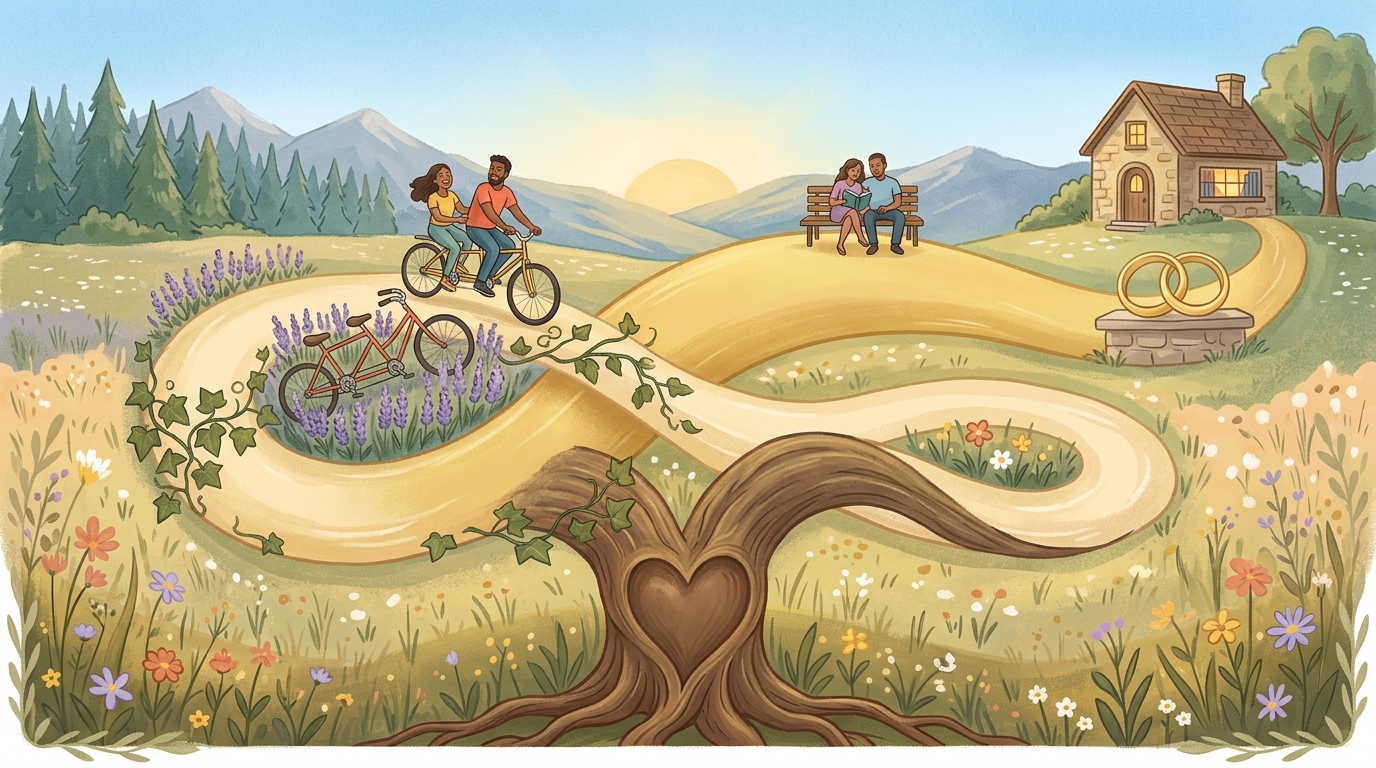
While popular culture often idealizes romantic attraction as love at first sight—sudden initial sparks and passionate lightning bolts—real life and relationship science show that durable loving relationships frequently follow different paths. The Storge style of love represents a gradual model of relationship formation grounded in shared history, mutual trust, and deep friendship. Drawing on psychological typologies and contemporary cross-cultural research, this article explores the distinct mechanisms that drive the storgic journey—its incremental developmental pace, low emotional volatility, and deep cultural resonance in societies that value enduring stability over fleeting passion. Discover why love growing from friendship represents one of the most resilient and psychologically adaptive foundations for long-term relational happiness.
1. Introduction: Beyond the Romantic Lightning Bolt
Western romantic narrative traditions heavily prioritize immediate physical attraction, affective surge, and the mysterious appraisals of “love at first sight” (Karandashev, 2017, 2019, 2026b). Modern popular media and historical traditions alike often frame authentic love as an unaccountable emotional event that strikes suddenly, sweeping individuals into acute passion. However, relationship science reveals that romantic relationship formation follows diverse cognitive and behavioral trajectories (Guerrero et al., 2020; Hendrick & Hendrick, 1986; Lee, 1973; Sprecher & Fehr, 2005).
As established in foundational descriptions of Lee’s love styles, Storge represents companionate affection that develops incrementally out of solid friendship. Rather than relying on initial physical intensity or emotional volatility, the storgic lover establishes intimacy through deep companionship, shared activities, and mutual loyalty over extended time horizons (Guerrero et al., 2020; Karandashev, 2026c; Lee, 1973, 1977).
While Eros operates through “love by revolution”—a sudden disruption of baseline psychological state—Storge operates through “love by evolution,” characterized by a gradual transition from social acquaintance to trusted friend, and ultimately to life partner (Karandashev, 2017, Lee, 1973). This sequential trajectory resembles broader models of interpersonal relationships, where mere exposure and familiarity reduce uncertainty to transform social peers into romantic partners. Understanding the Storge path requires examining how companionate foundations foster enduring relational security (Guerrero et al., 2020; Karandashev, 2026a; Morrow et al., 1995).
2. The Friendship-to-Love Transition: Phenomenological Dynamics
Rather than viewing Storge merely as a static personality orientation, relationship science understands it as a dynamic developmental path characterized by a non-conscious threshold shift. While erotic attraction operates through rapid affective appraisals, the storgic trajectory unfolds through continuous, daily micro-interactions grounded in shared activities, mutual lifestyle compatibility, and proven loyalty (Guerrero et al., 2020; Hendrick & Hendrick, 1995; Karandashev, 2026c; Lee, 1973).
Storgic Developmental Pathway
Baseline Friendship & Extended Mutual Familiarity
Shared Activities & Lifestyle
Joint Leisure Routines & Organic Daily Schedule Integration
Deep Mutual Trust & Loyalty
High Behavioral Predictability & Secure Attachment Base
Gradual Interpersonal Discovery
Extended Pre-Commitment Evaluation & Character Diagnostic Period
Natural Emergence of Commitment & Intimacy
Enduring Companionate Bond, Stress Buffering & Lifespan Stability
A phenomenological feature of the storgic path is the absence of a sudden turning point or clear boundary between platonic friendship and romance. Where erotic lovers report clear memories of the moment “chemistry” ignited, storgic partners are often unable to pinpoint when platonic companionship crossed into romantic feelings. Instead, individuals realize retrospectively that they have been in love for a considerable time—a phenomenon where emotional commitment matures naturally before it is explicitly categorized (Hendrick & Hendrick, 1986; Karandashev, 2017; 2026c; Lee, 1973, 1977).
This gradual transition is famously illustrated in Rob Reiner’s romantic comedy When Harry Met Sally… (1989). Over twelve years of evolving friendship, Harry Burns and Sally Albright share meals, personal disclosures, and candid mutual support without an immediate romantic spark. Rather than experiencing a dramatic shift driven by sudden physical passion, their relationship matures so gradually that their eventual transition into a committed, affectional, and intimate partnership feels like a natural continuation of their deep companionate trust. Across relationship studies, this companionate model correlates with high relational longevity, emotional security, and stable satisfaction over time. By prioritizing interpersonal understanding over initial volatility, the storgic transition lays an exceptionally secure cognitive foundation for long-term partnership (Guerrero et al., 2020; Hendrick & Hendrick, 1995; Morrow et al., 1995; Sprecher & Fehr, 2005).
3. Key Psychological Mechanisms of the Storge Path to Love
The distinct nature of storgic path to love rests on three interconnected psychological and behavioral mechanisms: evolutionary pace, low emotional volatility, and deep cultural integration (Guerrero et al., 2020; Karandashev, 2017; 2019; Lee, 1973).
3.1. Evolutionary Pace of Storge: Sequential Intimacy and Mere-Exposure Effect
The operational feature of Storge is its gradual, non-linear evolutionary pace. Rather than using physical touch or intense emotional declarations as entry points, storgic lovers build shared history, trust, commitment, and reliability prior to the escalation of romantic or sexual intimacy (Guerrero et al., 2020; Hendrick & Hendrick, 1995; Lee, 1973, 1977).
Psychologically, this developmental pace relies heavily on the mere exposure effect and uncertainty reduction mechanisms. As individuals engage in routine, shared activities—such as academic collaboration, shared hobbies, community involvement, or workplace partnerships—frequent interaction breeds familiar predictability. This familiarity reduces interpersonal anxiety and subcortical threat responses, cultivating a psychological climate of safety and mutual trust (Guerrero et al., 2020; Karandashev, 2017, 2026a; Lee, 1973; Sprecher & Fehr, 2005).
In storgic relationships, physical intimacy emerges naturally in later stages. Sexual involvement rarely functions as an evaluative test or a primary driver of attraction. Instead, this transition occurs once partners establish mutual trust, commitment, and a shared social identity. Consequently, storgic partners report low levels of performance anxiety and sexual insecurity, as physical expressions build upon a pre-existing bedrock of emotional safety (Guerrero et al., 2020; Hendrick & Hendrick, 1986; 1995; Lee, 1973; Lee, 1973; Morrow et al., 1995). This evolutionary shift from platonic familiarity to romantic awareness is vividly illustrated in both literature and history.
In Jane Austen’s classic novel Emma (1815), the relationship between Emma Woodhouse and Mr. Knightley develops over years of shared social life and candid mutual support without dramatic romantic upheaval. When Mr. Knightley’s potential marriage to another woman is suggested, Emma experiences the classic storgic realization—recognizing that ‘it darted through her with the speed of an arrow that Mr. Knightley must marry no one but herself’ (Austen, 1815/2003). Similarly, the real-life bond between British scholar C. S. Lewis and American writer Joy Davidman began as a transatlantic literary correspondence. Their relationship evolved into deep intellectual companionship and eventually transformed into a profound romantic marriage, demonstrating how storgic intimacy matures imperceptibly through shared familiarity.
3.2. Low Emotional Volatility: Stability over Obsessive Urgency
Storge displays exceptionally low emotional volatility compared to passionate styles like Eros or manic styles like Mania.
Passionate Eros and Mania styles are frequently characterized by acute emotional swings—ranging from euphoria in the presence of the beloved to severe anxiety, possessiveness, and intrusive thinking during periods of ambiguity (Guerrero et al., 2020; (Hendrick & Hendrick, 1986; Lee, 1973; Lee, 1977).
Unlike these turbulent love styles, storgic path to love avoids such emotional fluctuations. Storgic lovers experience minimal relational anxiety, jealousy, or intrusive thoughts because their relationship bond rests on established trust and transparent friendship. The relationship does not demand continuous affective reassurance or dramatic proof of devotion (Guerrero et al., 2020; Hendrick & Hendrick, 1995; Karandashev, 2026c; Lee, 1973; Morrow et al., 1995).
| Dimensional Feature | Passionate / Erotic Path (Eros) | Storgic Path (Storge) |
| Primary Catalyst | Physical chemistry, immediate visual/affective spark (Lee, 1973) | Deep companionship, shared history, mutual trust (Lee, 1973; Hendrick & Hendrick, 1986) |
| Developmental Pace | Rapid, revolutionary (“love at first sight”) (Lee, 1977; Karandashev, 2026b) | Incremental, evolutionary (friendship to romance) (Lee, 1973; Karandashev, 2026a, 2026c) |
| Emotional Profile | High intensity, acute affective surges, potential volatility (Guerrero et al., 2020) | Quiet stability, low anxiety, emotional security (Hendrick & Hendrick, 1995; Morrow et al., 1995) |
| Role of Communication | Expresses intense desire, idealization, and romantic destiny (Guerrero et al., 2020) | Transparent, task-oriented, grounded in shared goals (Guerrero et al., 2020; Karandashev, 2017) |
| Relational Focus | Individual passion and romantic chemistry (Lee, 1973) | Interpersonal loyalty, companionate harmony, family integration (Karandashev, 2017, 2019) |
The quiet emotional equilibrium of the storgic path to love is vividly illustrated in both literature and history.
In Leo Tolstoy’s War and Peace (1869), Pierre Bezukhov and Natasha Rostova’s eventual marriage grows out of deep spiritual companionship, shared suffering, and mutual understanding. Their bond emerges after the emotional turmoil of Natasha’s youth, offering a calm, resilient storgic shelter far removed from the anxiety of obsessive passion.
Similarly, the partnership of Nobel Prize–winning scientists Marie and Pierre Curie exemplifies how an enduring relationship can be based on shared intellectual devotion, quiet emotional equilibrium, and mutual respect buffers partners against severe professional and personal hardship.
Both of those examples demonstrate how storgic love replaces turbulent emotional fluctuations with task-oriented solidarity and enduring stability. The low emotional volatility in experiences and expressions of love provides high levels of psychological stability. When conflicts arise, storgic partners address disputes through constructive, task-oriented problem-solving rather than emotional withdrawal or defensive hostility. Because they view each other fundamentally as best friends, protecting the friendship and mutual respect remains paramount during disagreements (Guerrero et al., 2020; Hendrick & Hendrick, 1995; Lee, 1973; Morrow et al., 1995; Sprecher & Fehr, 2005).
3.3. Cultural Resonance of Storge: Social Alignment, Family Harmony, and Community Ties
While individualistic cultures often celebrate erotic intensity and romantic self-actualization, Storge carries valuable cultural resonance across many traditional societies worldwide. Cross-cultural studies on love attitudes demonstrate that storgic values are strongly emphasized in collectivist societies. These cultures prioritize family integration, community harmony, and long-term companionate stability over temporary individual passions (Karandashev, 2017, 2019; Lee, 1973).
The storgic model of love and relationships offers strong structural alignment in societies where marriage represents an alliance between extended families and social networks. A relationship grounded in friendship integrates smoothly into existing social circles. Extended family members and community peers readily welcome and validate a partner who is already known, trusted, and involved in shared social life (Guerrero et al., 2020); Karandashev, 2017, 2019).
Literary traditions and historical cross-cultural accounts powerfully illustrate how the romantic couple and their evolving storgic bond integrate into the broader matrix of extended families and community networks. Lao She’s modern Chinese novel Rickshaw Boy (駱駝祥子, Luòtuo Xiángzi, 1937) illustrates how traditional East Asian literature depicts relational stability and pair-bonding—not as products of romantic upheaval, but as unions forged through shared labor, community ties, and mutual devotion.
Similarly, historical accounts of traditional Greek and South Asian companionate marriages show that deep friendship and mutual respect frequently flourish after commitment through shared household stewardship, economic collaboration, and long-term family support. In these cultural ecologies, storgic love functions as an essential bridge, demonstrating how personal intimacy, family integration, and social harmony reinforce one another over time.
Furthermore, Storge serves as an essential foundation for Pragma—the rational and pragmatic love style. Without the companionate capacity of Storge, pragmatic partner selection risks collapsing into cold, transactional utility. Storge ensures that rational compatibility matures into genuine, enduring affection (Hendrick & Hendrick, 1995; Karandashev, 2026d; Lee, 1973, 1977).
4. Empirical Evidence and Relational Outcomes of the Storgic Path to Love
Quantitative studies in relationship science have validated the long-term benefits of the storgic path to love in committed partnerships (Guerrero et al., 2020; Morrow et al., 1995; Sprecher & Fehr, 2005). These empirical findings highlight several key relational advantages:
4.1. Marital Quality and Relational Satisfaction
In empirical research examining couples, Morrow, Clark, and Brock (1995) assessed how partners’ love styles influence marital quality and relationship satisfaction over time. Their findings demonstrated that high baseline levels of Storge strongly predict relationship stability and long-term marital quality, showing that Storge—like Eros—is a primary positive predictor of marital success.
While Eros generates high initial satisfaction that may decay over time if unmaintained, Storge provides an ascending or steady trajectory of satisfaction. Couples who score high on storgic subscales report greater companionate intimacy, higher shared leisure enjoyment, and superior mutual support during major life transitions, such as parenting, career shifts, or aging (Guerrero et al., 2020; Hendrick & Hendrick, 1995; Morrow et al., 1995; Sprecher & Fehr, 2005).
4.2. Attachment Security and Stress Buffering
From an attachment theory perspective, Storge aligns closely with relational dynamics of secure attachment. Securely attached adults demonstrate comfortable interdependence, open emotional expression, and confidence in their partner’s availability (Guerrero et al., 2020; Sprecher & Fehr, 2005).
The storgic developmental pathway allows prospective partners to evaluate each other’s reliability, emotional regulation, and attachment responsiveness over extended periods before making binding commitments. This pre-commitment evaluation period buffers against the risk of forming intense bonds with highly avoidant or anxiously attached partners. Consequently, storgic partnerships exhibit high resilience against external stressors, serving as an effective buffer against distress, economic adversity, and health challenges (Guerrero et al., 2020; Hendrick & Hendrick, 1995; Lee, 1973; Morrow et al., 1995; Sprecher & Fehr, 2005).
5. Conclusion: The Enduring Value and Quiet Strength of the Storgic Path to Love
In contemporary relationship culture—where digital dating platforms and visual media often prioritize rapid, superficial evaluation and immediate chemistry—re-examining the Storge path offers a valuable counterweight.
Relationship science demonstrates that lasting romantic relationships do not require an initial emotional storm or instant physical spark. The storgic model reveals that deep, passionate, and enduring romantic connections can cultivate gradually from shared values, trust, mutual respect, and loyal friendship.
By valuing the evolutionary pace of friendship, minimizing emotional volatility, and building upon shared social foundations, the Storge path provides a quiet, durable, and highly adaptive roadmap for long-term human connection.
Related Research in This Series
This article concludes a 7-part scholarly exploration of love styles, relational pathways, and psychological mechanisms published in The Diversity of Love Journal.
Previous Articles in This Series
- October 4, 2026: The Mystery of Love: Conceptual Frameworks, Cultural Beliefs, and Scientific Inquiries
- October 5, 2026: The Mystery of Love at First Sight: Psychological Insights and Scientific Evidence
- October 6, 2026: The Science of Love at First Sight: Cultural Frameworks and Intuitive Judgments
- October 7, 2026: How Love Makes Us Irrational: Cognitive Biases of Intuition and Magic
- October 9, 2026: The Slow Path to Love: Mere Exposure, Familiarity, and Sequential Interpersonal Discovery
- October 10, 2026: The Pragma Path to Love: Rational Compatibility and Evaluative Selection
References
- Guerrero, L. K., Andersen, P. A., & Afifi, W. A. (2020). Close encounters: Communication in relationships (6th ed.). SAGE Publications.
- Hendrick, C., & Hendrick, S. S. (1986). A theory and method of love. Journal of Personality and Social Psychology, 50(2), 392–402.
- Hendrick, S. S., & Hendrick, C. (1995). Gender differences and similarities in sex and love. Personal Relationships, 2(1), 55–65.
- Karandashev, V. (2017). Romantic love in cultural contexts. Springer International Publishing.
- Karandashev, V. (2019). Cross-cultural perspectives on the experience and expression of love. Springer.
- Karandashev, V. (2022). Cultural typologies of love. Springer.
- Karandashev, V. (2026a, October 9). The slow path to love: Mere exposure, familiarity, and sequential interpersonal discovery. The Diversity of Love Journal. https://love-diversity.org/slow-path-to-love-mere-exposure-familiarity/
- Karandashev, V. (2026b, October 6). The science of love at first sight: Cultural frameworks and intuitive judgments. The Diversity of Love Journal. https://love-diversity.org/the-science-of-love-at-first-sight/
- Karandashev, V. (2026c, July 26). The Storge style of love: Understanding the companionate path to stability. The Diversity of Love Journal. https://love-diversity.org/what-is-the-storge-love-style/
- Karandashev, V. (2026d, October 10). The Pragma path to love: Rational compatibility and evaluative selection. The Diversity of Love Journal. https://love-diversity.org/pragma-path-to-love/
- Lee, J. A. (1973). Colours of love: An exploration of the ways of loving. New Press.
- Lee, J. A. (1977). A typology of styles of loving. Personality and Social Psychology Bulletin, 3(2), 173-182.
- Morrow, G. D., Clark, E. M., & Brock, K. F. (1995). Individual and partner love styles: Implications for the quality of romantic involvements. Journal of Social and Personal Relationships, 12(3), 363–387.
- Sprecher, S., & Fehr, B. (2005). Compassionate love for close others and humanity. Journal of Social and Personal Relationships, 22(5), 629–651.