Reclaiming the Complexity of John Lee’s Ludus Style of Love
Modern relationship research often reduces the Ludus style of love to a simple score on a survey—tagging it as mere casual dating or uncommitted game-playing. But Canadian sociologist John Alan Lee’s original 1970s typology revealed something far richer: a coherent, highly structured approach to romance centered on autonomy, permissive choices, and emotional boundary management.
This article explores the theoretical roots, empirical methodology (including Lee’s groundbreaking Love Story Card Sort), and historical contexts of the ludic lover. Trace how Ludus evolved from a rich, multi-dimensional persona into a modern attitude variable, and discover why returning to Lee’s qualitative foundations changes how we understand non-traditional romantic dynamics today.
Historical Context: The Paradigm Shift in Love Research
The scientific study of love underwent a major paradigm shift in the 1970s, largely driven by Canadian sociologist John Alan Lee (1933–2013). Lee introduced a comprehensive typology of love styles, offering a systematic framework for understanding individual differences in how people experience, express, and enact love (Lee, 1973, 1976). His work established a foundation for love research and profoundly shaped the field’s methodological and conceptual evolution (Karandashev, 2022).
Over decades of subsequent scholarship, Lee’s original conceptualizations have frequently been condensed into simplified shortcuts and truncated descriptors. This loss of theoretical nuance has often obscured the original depth of his typology, particularly regarding the Ludus style of love.
Theoretical Foundations: Lee’s Conceptual Framework
Lee (1973, 1976) conceptualized love styles as distinct, holistic types that encompass several phenomenological planes:
- Personal beliefs, ideas, and values regarding love
- Specific love attitudes and self-perceived identity
- Actual relational behaviors, expressions, and interactions
J. Lee noted a discrepancy during his research: a “puzzling contradiction between the opinions which subjects said they held about true love and the behaviour they reported enacting when actually in a love relationship” (Lee, 1977, p. 176). To resolve this, his typology evaluated both stated attitudes and enacted behaviors.
The Color Analogy and Typological Structure
Ludus is one of the three primary love styles identified by John Alan Lee.
To illustrate the structural relationships among these love styles, Lee (1973, 1976, 1977) introduced an illustrative taxonomy inspired by primary, secondary, and tertiary colors:
- Primary Styles: Eros (passionate, physical attraction), Ludus (playful, game-playing love), and Storge (companionate, friendship-based love).
- Secondary Styles: Formed by combining two primary styles:
- Tertiary Styles: Formed by further mixing primary and secondary attributes (e.g., manic ludus, storgic eros).
Within this taxonomic system, Ludus stands as a primary, foundational love style. It represents a permissive, pluralistic, and playful approach to love. Individuals demonstrating a ludic style consciously control their emotional investment, avoid deep future commitments, and often engage in multiple simultaneous or short-lived relationships to preserve autonomy, prevent jealousy, and avoid over-involvement (Karandashev, 2022; Lee, 1973).
John Lee grounded his theory of love styles in the context of the socio-cultural frameworks and explained how cultural ideologies framed modern styles of love.
Here is how Lee theoretically described the Ludus love style:
“Individuals with the Ludus love style are playful and game-loving in their expressions and behaviors. They are pluralistic and permissive in their choices and actions. They often engage in multiple and relatively short-lived relationships. They tend to control their involvement in a relationship in an attempt to avoid the feeling of jealousy.”
(Excerpt from Karandashev, 2022, p. 78).
Empirical Identification: The Love Story Card Sort
To identify these typologies empirically, Lee developed the Love Story Card Sort, an innovative, systematically coded interview procedure (Lee, 1973, 1977).
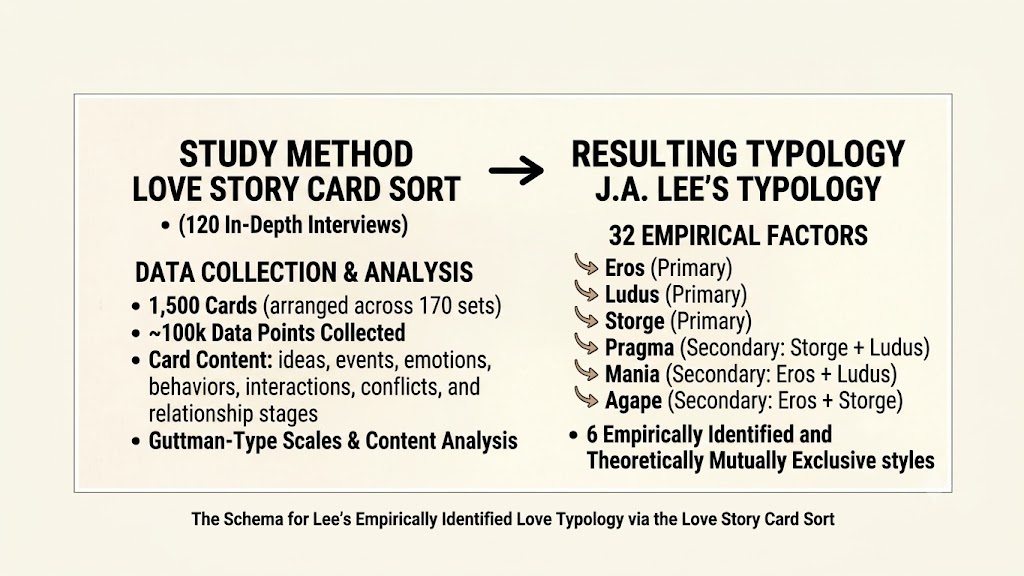
The method utilized 1,500 cards arranged across 170 thematic sets. Each card detailed a specific idea, event, or emotion that could occur in a relationship. Participants selected cards to build an “omnibus love story” reflecting their personal experiences (Lee, 1977).
This approach provided a structured yet deeply sensitive qualitative framework:
- Rich Data Yield: In-depth interviews with 120 participants yielded roughly 100,000 data points (Karandashev, 2022).
- Factor Analysis: A basic factor analysis on Guttman-type scales extracted 32 distinct factors, establishing six empirically distinguishable, mutually exclusive love styles—a structure independently verified by Lasswell and Lasswell (1976) using Guttman-Lingoes Smallest Space Analysis.
Empirically Identified Descriptions of the Ludus Style of Love
The features of the Ludus style of love, which Lee identified based on this analysis, are as follows:
“Participants with Ludus style recall their childhood as average. They consider their present life satisfactory, yet do not often feel enthusiastic about it. They like the broader range of physical types in potential partners, are not very selective, and can easily change their preferences. They do not fall in love in the typical sense. They continue the regular activities as usual and wish the love relationships would adapt to their existing schedule of life. They are not willing to commit themselves and settle down, thoroughly avoiding future commitment to the partner and relationship. They do not like to plan far ahead for any events.
The lovers of the Ludus style make an effort to prevent too much involvement and intimacy in relationships by avoiding seeing the beloved too often and preventing over-involvement on either side. They may often discuss the problems of involvement with a partner to minimize the feelings of involvement.
A lover of the Ludus style can play openly, honestly telling the truth to the partner, or can deceive and lead the partner on. The lover, who plays a fair love game, tends to go on and enjoy the ludus style of relationship with the current and next partner. The cheating lover may accumulate the feeling of guilt that sooner or later spoils the joy of the game.
The lovers of the Ludus style enjoy sexual intimacies as pleasant feelings, entertaining plays, and fun games rather than as genuine, passionate connections. Generally, ludic lovers are not prone to experiencing jealousy or feeling rivalry. They expect that the partner also does not feel and does not show jealousy.
When the relationship is not enjoyable anymore, the lovers of the Ludus style think they have a reason to end it. They can easily find an alternative partner. To avoid being bored, they like to have two or three partners for different activities and on different nights of the week. The partners are usually not ignorant of each other’s existence. This knowledge prevents them from becoming overly engaged.”
(Excerpt from Karandashev, 2022, p. 81).
Based on factor analysis and interview data, Lee delineated the detailed profile of the ludic lover across various developmental, cognitive, and relational domains (Karandashev, 2022; Lee, 1973, 1976):
As this description shows, the Ludus love style represents a distinct cluster of personal beliefs, attitudes, behaviors, and individual identity exhibited by men and women in romantic relationships. They characterize the attitudes, experiences, expressions, behaviors, and interactions of lovers. These distinct characteristics can be distinguished empirically. They are connected in a typical manner that defines the typological structure of Ludus (Karandashev, 2022).
Salient Characteristics of the Ludus Style of Love
Background and Expectations
- Personal History: Ludic lovers typically describe their childhoods as average and report being generally satisfied with their present lives, though rarely enthusiastic.
- Partner Preferences: Unlike erotic lovers (who have a strict ideal physical type), ludic lovers accept a broad spectrum of physical types, display low selectivity, and easily adjust their preferences over time.
- Integration with Daily Life: They do not “fall in love” in the traditional sense. Instead, they expect romantic interactions to fit around their existing routines, hobbies, and schedules.
Commitment and Involvement Control
- Avoiding Over-Involvement: Ludic lovers actively limit contact frequency and avoid far-future planning to prevent deep emotional attachment on either side. They frequently discuss involvement boundaries directly with partners to keep expectations low.
- Pluralistic Relationships: To prevent boredom and safeguard personal autonomy, ludic lovers often maintain two or three concurrent partners for different activities or days of the week. These partners are rarely kept entirely secret from one another; mutual awareness acts as a natural buffer against deeper emotional demands.
Game-Playing Dynamics and Dissolution
- Fair vs. Deceptive Play: Ludic lovers can play the game transparently by stating their intentions clearly, or deceptively by leading partners on. However, deceptive play often generates guilt that eventually ruins the fun of the game.
- Sexuality as Entertainment: Sexual intimacy is viewed as fun, lighthearted recreation rather than a deep, passionate bond.
- Low Jealousy: Ludic lovers rarely feel jealousy or rivalry, and they expect the same detachment from their partners.
- Low-Friction Dissolution: When a relationship ceases to be enjoyable, ludic lovers treat this as a clear reason to end it, moving on easily to an alternative partner.
Historical, Cultural, and Ideological Contexts
Lee argued that love styles do not exist in a vacuum; they reflect broader, socially endorsed systems of thought—or cultural ideologies—promoted by specific historical institutions and philosophies (Lee, 1975, 1977):
- Ludus in Antiquity: In the Greco-Roman era, cultural norms celebrated love as an adventurous game, an art of seduction, and entertainment rather than a sacred bond .
- Ideological Shifts: The rise of Christianity introduced an agapic ideology centered on altruistic duty, directly opposing the playful Roman ludus. Later, feudal societies favored a pragmatic ideology to support arranged marriages, while 12th-century courtly love fostered a romantic/manic view of passion.
While all six love styles appear across human history, specific societal conditions make certain styles more culturally favored during given eras (Lee, 1975).
From Love Styles to Love Attitudes: Methodological Shifts
The conceptualization of love styles underwent a significant transformation when Clyde Hendrick and Susan Hendrick developed the Love Attitude Scale (LAS) (Hendrick & Hendrick, 1986; Hendrick et al., 1998; Hendrick & Hendrick, 2006).
While Hendrick and Hendrick adopted Lee’s six labels (Eros, Ludus, Storge, Pragma, Mania, Agape), their psychometric approach fundamentally altered how love was measured:
| Theoretical Dimension | Lee’s Original Typology (1973, 1976) | Hendrick & Hendrick LAS (1986, 1998) |
| Primary Unit of Analysis | Person / Case (Holistic, multi-faceted type) | Variable (Continuous subscale score) |
| Data Collection | Structured qualitative “Love Story Card Sort” | Quantitative Likert-type survey items |
| Scope of Measurement | Comprehensive: beliefs, identity, emotions, and specific behaviors | Focused primarily on self-reported attitudes |
| Secondary / Tertiary Styles | Structurally conceptualized (e.g., Mania = Eros + Ludus) | Abandoned in favor of six independent continuous subscales |
Implications of the Shift
The Ludus love style is a type of love rather than a variable, how it is measured with the Love Attitude Scale (LAS, Hendrick & Henrick, 1986, 1998). Converting Lee’s holistic, multi-dimensional styles into single-dimension attitude variables made love research much more accessible, leading to widespread cross-cultural studies using the LAS (Karandashev, 2019, 2022).
However, this shift also reduced Lee’s complex, typological structure to individual subscale scores. In survey research, an individual’s “love style” is often reported as a simple profile of continuous scores rather than an integrated personal identity (Hendrick & Hendrick, 2006). This methodological shorthand is why modern research often treats Ludus merely as a score on a game-playing attitude scale, rather than the rich, highly structured pattern of behavior, commitment management, and personal autonomy originally mapped by Lee.
Conclusion: The Ludus Style of Love is a Love Type
The Ludus love style is far more than a simple preference for casual dating or game-playing. Viewed through John Alan Lee’s original theoretical framework and empirical findings, Ludus represents a distinct, coherent love type—a playful path to autonomy characterized by intentional emotional control, permissive choices, low selectivity, and a conscious effort to keep relationships lighthearted and fun. Reconnecting modern love research with Lee’s qualitative and typological foundations allows for a much richer understanding of ludic lovers and the complex ways human beings navigate romantic connections.
References
- Hendrick, C., & Hendrick, S. (1986). A theory and method of love. Journal of Personality and Social Psychology, 50(2), 392–402.
- Hendrick, C., & Hendrick, S. S. (2006). Styles of romantic love. In R. J. Sternberg & K. Weis (Eds.), The new psychology of love (pp. 149–170). Yale University Press.
- Hendrick, C., Hendrick, S. S., & Dicke, A. (1998). The love attitudes scale: Short form. Journal of Social and Personal Relationships, 15(2), 147-159.
- Karandashev, V. (2022). Cultural typologies of love. Springer Nature.
- Karandashev, V. (2019). Cross-cultural perspectives on the experience and expression of love. Springer.
- Lasswell, T. E., & Lasswell, M. E. (1976). I love you but I’m not in love with you. Journal of Marital and Family Therapy, 2(3), 211-224.
- Lasswell, M., & Lobsenz, N. M. (1980). Styles of loving: Why you love the way you do. Doubleday.
- Lee, J. A. (1973). Colours of love: An exploration of the ways of loving. New Press.
- Lee, J. A. (1976). The colors of love. Prentice-Hall.
- Lee, J. A. (1977). A typology of styles of loving. Personality and Social Psychology Bulletin, 3(2), 173-182.