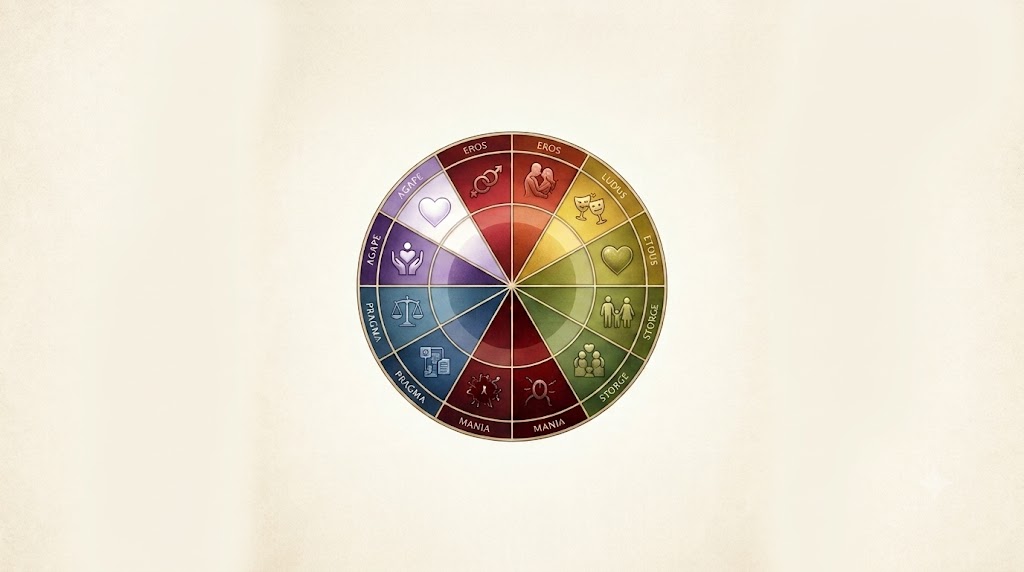
What are the different types of love? Since the middle of the 20th century, the typology of love has been an interesting topic of inquiry for many people and love researchers. Scholars of love have proposed many different types of love (Karandashev, 2022).
The love studies of the 1970s presented substantial advancements in our understanding of typological differences in the ways people love in romantic relationships (Lasswell & Lasswell, 1976; Lasswell & Lobsenz, 1980; Lee, 1973, 1976).
John Alan Lee (1933–2013), a Canadian social researcher, was among the key scholarly figures in love studies during the 1970s and 1980s.
John Alan Lee’s Contribution to the Studies of Love
The typology of love styles he proposed has substantially affected the love studies of the following decades (Karandashev, 2022). So, I could say he was a genius in the research of love who made major steps forward in our scholarly understanding of the various personality types associated with romantic love relationships.
Love researchers quickly adopted Lee’s (1973) categorization of love styles and widely used them in their studies in the following decades. Despite the popularity of Lee’s love styles in modern love research, contemporary publications often misrepresent his theory and method to some extent. They sometimes interpret the love styles in ways that deviate from Lee’s original conceptualization. So, this article rectifies these misinterpretations and presents Lee’s original theory and method.
Crucially, many modern interpretations overlook how deeply Lee believed these styles were rooted in broader social history (for a detailed exploration of this macro-level background, see our recent analysis on how cultural ideologies framed modern styles of love).
Here Are the Core Points of Lee’s Theory of Love Styles
The theory describes the typology of individual ways men and women approach their love relationships. The theory embraces several phenomenological planes, including love ideas, beliefs, attitudes, personal identity in love, and love behavior. It is worth noting that the author noted
“a puzzling contradiction between the opinions which subjects said they held about true love and the behaviour they reported enacting when actually in a love relationship.”
(Lee, 1977, p. 176).
The six love styles in the typology represent the distinctive clusters of personal beliefs, attitudes, behaviors, and individual identity that men and women exhibit in love. These individual attributes are related to one another and are empirically distinguishable. They characterize the love attitudes, experiences, expressions, actions, and interactions of lovers. Lee denoted these love styles with conventional labels borrowed from the Greek and Latin lexicon of love.
A Comprehensive Description of the Six Love Styles by John Lee
Over the years of love research and publications, the original author’s descriptions of the six love styles he proposed have been abridged and reduced to some shortcuts. These truncated attributes have distorted, to some extent, Lee’s original meanings.
Lee’s descriptions of the six love styles can be summed up in the following ways:
- Individuals with Eros love style are very interested in and fascinated by the physical appearance of a potential partner. The lovers perceive in a beloved the physical type concordant with their ideal image of the beautiful. Physical romantic attraction is a central tenet of their love.
- Individuals with Ludus love style are playful and game-loving in their expressions and behaviors. They are pluralistic and permissive in their choices and actions. They often engage in multiple and relatively short-lived relationships. They tend to control their involvement in a relationship in an attempt to avoid the feeling of jealousy.
- Individuals with Storge love style tend to avoid self-conscious passion, slowly disclosing their selves and gradually building up affection and companionship, with the expectation of long-term commitment.
- Individuals with Mania love style are emotionally intense, very obsessive and preoccupied with the beloved, and therefore frequently jealous. They crave repeated reassurance of being loved.
- Individuals with Agape love style feel it is their duty to love another with no expectation of reciprocity. Reasons, rather than emotions, guide their feelings and actions. They are caring, altruistic, and gentle.
- Individuals with Pragma love style deliberately consider how suitable a potential beloved is for their prospective relationship. They look for a compatible match, taking into account the age, religion, education, vocation, and other demographic characteristics of a prospective partner.
(Reproduced from Karandashev, 2022).
J. Lee convincingly showed in his research that these modern ways of loving can be rooted in certain cultural ideologies of the past. A concise overview of Lee’s explanation is provided in another article in this journal.
The Hierarchical Structure of Love Styles
The author proposed the hierarchical taxonomic structure of these love styles (Lee, 1973, 1976). So, he illustrated this love typology with a circle of love. A color system provided an illustrative analogy that would be meaningful to represent love styles as a vivid taxonomical system. The colors themselves have no special meanings. Their ability to mix with each other and overlap demonstrates their complex relationships.
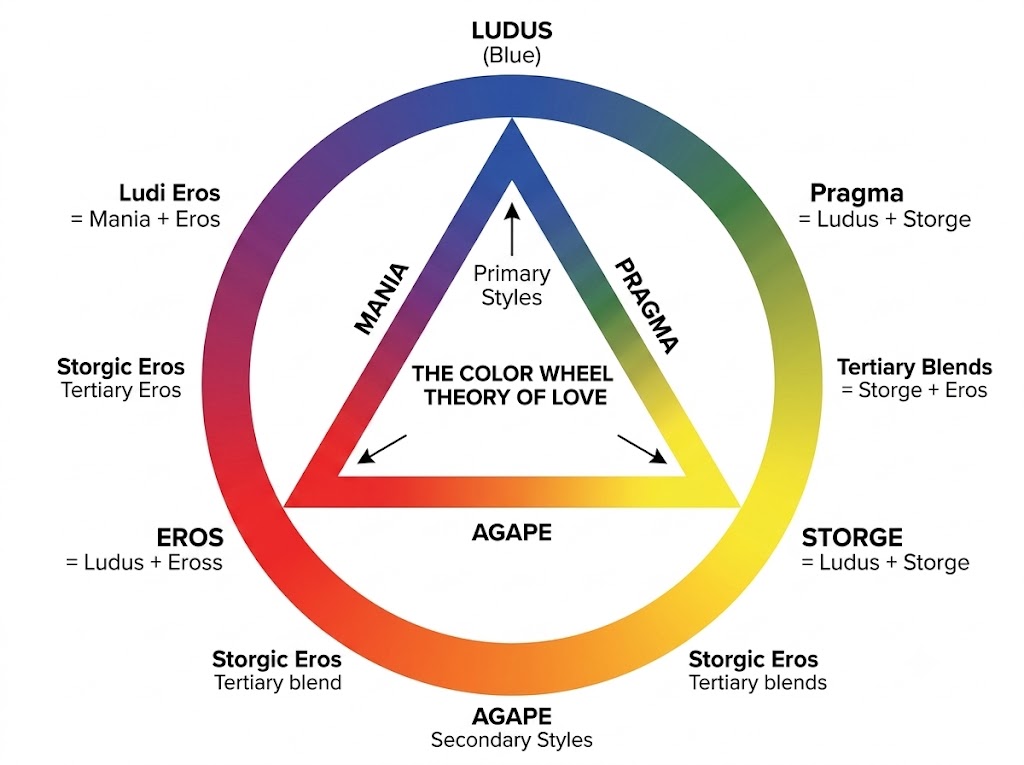
Figure 1. John Alan Lee’s structural taxonomy of love styles represented as a color wheel, illustrating the intersection of primary, secondary, and tertiary styles.
Conceptually, the relationship between primary, secondary, and tertiary colors resembles the operational structure of the love styles themselves (Lee, 1977). Just as secondary and tertiary colors on a visual spectrum are formed by mixing primary colors, secondary and tertiary love styles are constructed out of a blend of the fundamental primaries. Within this taxonomy, Storge, Ludus, and Eros serve as the primary love styles—the foundational hues of love. As illustrated in Figure 1, the simplest secondary styles are Pragma, Mania, and Agape.
The simplest secondary styles are Pragma, Mania, and Agape. Typologically, these secondary styles represent a combination of features salient for pairs of primaries, showing how love as an experience of relationships differs from love as static relationships. For instance:
- Pragma is constructed from a combination of the features of Storge and Ludus. It represents a realistic, practical approach to romance, blending strategic, careful selection with a desire for stable, long-standing compatibility.
- Mania is a combination of the features of Eros and Ludus. This yields an emotionally intense, obsessive, and possessive love style marked by both passionate attraction and game-playing emotional volatility.
- Agape represents a combination of the features of Storge and Eros. This produces a deeply caring, altruistic, and selfless love that is guided by unconditional duty and compassionate devotion without the expectation of reciprocity.
Beyond these classic mixtures, Lee identifies other secondary blends along the spectrum, such as storgic eros, storgic ludus, and ludic eros. The system grows more intricate with the introduction of tertiary love styles—such as manic eros, manic storge, and manic ludus—which incorporate features of a secondary style mixed further with a primary base (Lee, 1973, 1977).
As this architectural framework demonstrates, Lee’s color system provides a deeply resonant visual analogy. The colors themselves hold no fixed, isolated meanings; rather, their capacity to intersect, blend, and overlap illustrates the complex, intertwined ways in which people love. While the underlying taxonomy proves difficult to map in full, the color wheel remains an invaluable model for capturing the vast diversity of interpersonal love.
Comparative Overview of Love Typologies
Over the years, conceptualizations of Lee’s styles of love and their empirical descriptions have shown a multifaceted, comparative view of these styles, see the Table 1 below.
Figure 1. Comparative Overview of Love Typologies
| Love Style | Primary Focus | Motivation | Approach to Reciprocity |
| Agape | Partner’s welfare & growth | Moral duty, altruism, empathy | Given freely without expecting returns |
| Pragma | Compatibility & stability | Rational fit, shared life goals | Balanced exchange and social equity |
| Eros | Physical & romantic passion | Chemistry, attraction, idealization | Mutual passion and intimacy |
| Storge | Companionship & trust | Deep friendship, shared history | Mutual loyalty and slow-building care |
| Ludus | Autonomy & fun | Entertainment, low commitment | Non-binding, independent engagement |
| Mania | Validation & obsession | Fear of loss, emotional dependency | High demand for constant reassurance |
Why the C. Hendrick and S. Hendrick Love Attitudes Scale Is Not About “Love Styles”
Despite a widespread misconception that has persisted for decades, C. Hendrick and S. Hendrick’s theory and their Love Attitudes Scale (LAS) do not measure love styles as originally conceptualized in J. Lee’s foundational work. As the scale’s name explicitly indicates, Hendrick and Hendrick’s theory and method evaluate love attitudes. Although the authors adopted Lee’s overarching taxonomy and conceptual notions, they drastically reframed them from a methodological standpoint, transforming Lee’s love styles into quantifiable love attitudes (Karandashev, 2022).
This psychometric framework reincarnated Lee’s (1973, 1976) typological theory into a survey-based love attitudes framework (Hendrick & Hendrick, 1986; Hendrick et al., 1998). The new instrument appropriated the same original labels—eros, storge, pragma, agape, mania, and ludus. However, the LAS introduced a different methodological approach to operationalize these constructs: rather than capturing broad, multidimensional profiles of what individuals experience, as well as how they express themselves and behave in their relationships, the scale measures underlying cognitive and evaluative attitudes toward love.
Why Scale Variables Should Not Be Labeled “Love Styles”
Lee’s original methodology was a comprehensive, qualitative exploration of various love experiences, expressions, and behaviors across different phases of a love relationship. Using structured interviews, Lee collected detailed self-reports regarding participants’ life events, feelings, cognitions, and actions. In this qualitative format, love styles represented typological portraits of the complex and multifaceted ways people love. While this interview-based approach provided complex descriptive insights, it was inherently time-consuming and difficult to standardize across large populations.
Consequently, Hendrick and Hendrick’s adaptation shifted toward a brief self-report rating scale (Hendrick & Hendrick, 1986; Hendrick et al., 1998). By translating Lee’s broad behavioral and experiential typologies into concise Likert-type items, the LAS successfully made the construct accessible for broad empirical research—but in doing so, it altered the variables themselves from a broad, multifaceted styles to measurable attitudes (Karandashev, 2022).
References
- Hendrick, C., & Hendrick, S. (1986). A theory and method of love. Journal of Personality and Social Psychology, 50(2), 392–402.
- Hendrick, C., Hendrick, S. S., & Dicke, A. (1998). The love attitudes scale: Short form. Journal of Social and Personal Relationships, 15(2), 147-159.
- Karandashev, V. (2022). Cultural typologies of love. Springer Nature.
- Lasswell, T. E., & Lasswell, M. E. (1976). I love you but I’m not in love with you. Journal of Marital and Family Therapy, 2(3), 211-224.
- Lasswell, M., & Lobsenz, N. M. (1980). Styles of loving: Why you love the way you do. Doubleday.
- Lee, J. A. (1973). Colours of love: An exploration of the ways of loving. New Press.
- Lee, J. A. (1976). The colors of love. Prentice-Hall.
- Lee, J. A. (1977). A typology of styles of loving. Personality and Social Psychology Bulletin, 3(2), 173–182.